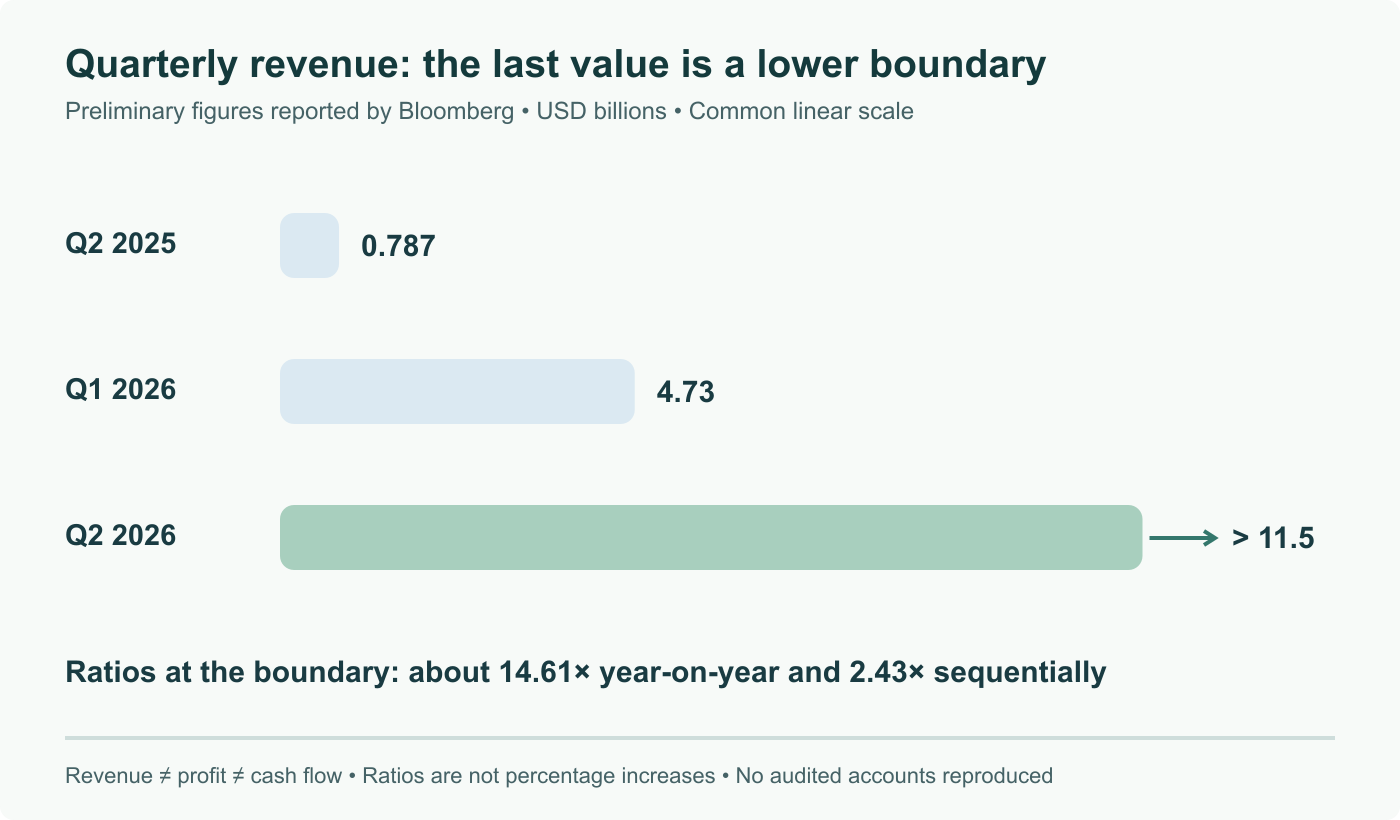
Anthropic booked more than eleven and a half billion dollars of revenue in the second quarter of 2026, according to preliminary figures reported on August 14 and confirmed more widely the following day. That is roughly fourteen times the seven hundred and eighty seven million dollars it recorded in the same quarter last year, and well over double the four point seven three billion of the first quarter. The company also posted positive adjusted operating income. The numbers land while it prepares to list publicly, which is the part that matters if your production systems call its models.
The short answer
Anthropic recorded more than eleven and a half billion dollars of revenue in the second quarter of 2026, against seven hundred and eighty seven million a year earlier and four point seven three billion in the first quarter, according to preliminary figures reported on August 14 and confirmed more widely on August 15. The company also posted positive adjusted operating income. It is preparing a public listing as soon as October, working with Morgan Stanley, Goldman Sachs and JPMorgan Chase. Figures are preliminary and could be revised.
Revenue numbers from private companies normally deserve a shrug. They arrive without an audit, framed by whoever benefits from the framing. This set is worth reading anyway, because the comparison points are close enough together to be checked against each other, and because the company producing them is about to become one many engineering teams depend on in a new way.
The figures
Preliminary revenue for the second quarter of 2026 came in above eleven and a half billion dollars. The comparison that gets the headline is the year ago quarter at seven hundred and eighty seven million, which works out at roughly fourteen times growth. The more informative comparison is the previous quarter at four point seven three billion, because three months is short enough that the same customers are mostly still there.
Half year revenue therefore sits around sixteen point two billion dollars. Annualising the quarter gives approximately forty six billion, which lines up with the roughly forty seven billion annualised run rate reported in May. Those two calculations use different methods, so agreement between them is a mild signal of health rather than a coincidence: run rate typically takes the latest month and multiplies by twelve, and it diverges from quarterly annualisation when growth is lumpy or front loaded.
The company also reported positive adjusted operating income. Read the adjective. Adjusted figures exclude items chosen by whoever prepares them, and in this industry the usual candidates are model training runs, share based compensation and multi year compute commitments. None of those costs disappear because a line item does.
The listing behind the numbers
Preliminary figures published weeks before a possible offering are not an accident of the calendar. Anthropic filed its prospectus confidentially, is working with Morgan Stanley, Goldman Sachs and JPMorgan Chase, and backers have pointed to a debut as soon as October. We covered the earlier stage of that process when bankers began scheduling investor meetings in July.
Valuation expectations attached to the listing are circulating freely and should be treated as expectations. The last number with an actual transaction behind it is the private round completed in May. Anything larger is a forecast until a range is filed, and forecasts in this sector have a poor record of surviving contact with a market that has started asking about the cost side of the buildout.
What a public vendor does differently
This is the part that reaches your code, and it is more mundane than the headline.
Public companies are rewarded for predictable revenue, so expect more emphasis on committed contracts, seat based pricing and enterprise agreements, and less appetite for open ended experimentation on the pricing page. Expect closer attention to gross margin per request, which is the mechanism behind cheaper small models being pushed as the sensible default for high volume work. And expect published deprecation schedules to get more disciplined rather than less, because a listed company with enterprise customers cannot afford to break production quietly.
That last point cuts in your favour, but only if you are set up to use it.
Three habits worth adopting before the listing
Pin model versions where you can change them without a deploy. A dated model identifier in configuration or an environment variable is the difference between a fifteen minute change and a release cycle when a deprecation notice arrives with sixty days on it.
Keep an evaluation suite that runs against any provider. Twenty or thirty representative cases with expected outputs, runnable from one command, is enough. Teams that have this can answer the question "what breaks if we switch" with a number. Teams that do not are answering with a feeling, and feelings do not survive a budget meeting.
Watch price per task rather than price per token. Pricing pressure in this market shows up as cheaper models that need more attempts, or as reasoning modes that improve quality while multiplying token counts. The only figure that tracks what you actually pay is cost per completed unit of work, measured on your workload, not on a benchmark.
The honest summary
A quarter above eleven and a half billion dollars, growing fourteen fold year over year with a positive adjusted operating line, describes a business that has found its market. It does not describe a settled one. Two of the largest model providers are cutting prices while another raises them, capacity commitments across the sector run into the hundreds of billions, and none of the companies involved has demonstrated what steady state margins look like.
Build accordingly. Depend on the capability, stay flexible about the supplier, and keep the switching cost low enough that you never have to find out how expensive it would have been.
Sources and further reading
- Anthropic revenue reportedly jumps to more than $11.5 billion in second quarter, CNBC, August 15, 2026
- Anthropic revenue surges to over $11.5 billion in second quarter, Fortune, August 15, 2026
- Anthropic Revenue Surges to Over $11.5 Billion in Second Quarter, Bloomberg, August 14, 2026
- Anthropic's quarterly revenue passed $11.5bn, up more than 14 fold, The Next Web, August 2026
- Anthropic quarterly revenue eclipses $11.5 billion amid IPO prep, Yahoo Finance, August 2026
Frequently asked questions
What was actually reported, and by whom?
Bloomberg reported preliminary second quarter figures on August 14, 2026, and the numbers were picked up widely the next day. Revenue came in above eleven and a half billion dollars for the quarter, compared with seven hundred and eighty seven million in the same quarter of 2025 and four point seven three billion in the first quarter of 2026. The company also recorded positive adjusted operating income. These are preliminary figures reported ahead of a listing rather than audited statements, so treat them as directionally reliable and subject to revision.
How does this square with the run rate figures published earlier?
Reasonably well, which is a useful check. Annualising the quarter gives roughly forty six billion dollars, and the company was reported at about forty seven billion of annualised run rate in May. Run rate is normally computed from the most recent month multiplied by twelve, so the two methods should not match exactly. When they land close together it suggests growth is broad rather than concentrated in one large contract signed at the end of a period. Half year revenue works out at roughly sixteen point two billion dollars.
Does positive operating income mean the company is profitable?
Not in the sense most people mean. The figure reported is positive adjusted operating income, and the adjustments are where the interesting detail sits. Model training costs, share based compensation and long term compute commitments are the usual candidates for exclusion, and none of them stop being real costs. What the number does tell you is that the gap between revenue and the direct cost of serving that revenue has closed enough to show a positive line, which is a genuine change from a year ago even with the caveats attached.
What does this mean for the IPO?
It makes an autumn listing more plausible. The company filed confidentially and is working with Morgan Stanley, Goldman Sachs and JPMorgan Chase, with backers pointing to an October debut, and figures like these are the ones that get shown to prospective investors before a roadshow. Valuation expectations circulating around the listing are estimates rather than settled prices, and the last figure with a real transaction behind it remains the private round completed in May. We would read published targets as ambitions until a range is formally filed.
Why should this matter to anyone just building on the API?
Because a listed vendor behaves differently from a private one. Quarterly reporting rewards predictable revenue, which usually means more push toward committed contracts and seats, tighter attention to gross margin per request, and cleaner published deprecation schedules because a public company cannot afford surprise breakage in front of enterprise customers. The practical response is unglamorous. Pin model versions in configuration rather than code, keep an eye on the deprecation calendar, and make sure your prompts and evaluation suite would survive being pointed at another provider.