Comparing ChatGPT vs Claude vs Gemini to pick the best AI model in 2026? I pay for all three out of my own pocket and hammer their APIs at work every day, so this is not a spec-sheet drive-by. Three families are left standing: ChatGPT (GPT-5 turbo and mini), Claude (Opus 4.8 and Sonnet 4.6), Gemini (3.0 Pro and Flash). They are all good now. The gaps only surface when you put a real job in front of them. So I ran ten jobs I actually use, picked the one I would open first for each, and built a cheat-sheet keyed to whatever eats your day.
The short answer
There is no single winner in 2026, and anyone handing you one answer is selling you something. Claude wins code and long-form writing and dense vision. Gemini wins grounded research, audio and 2M-token context. ChatGPT wins end-to-end data analysis and multi-tool agents. The right move is to route: pick the model per job.
I pay for all three. Out of my own pocket, and I hammer their APIs at work every day, so no, this isn't a spec-sheet drive-by. Three families left standing: ChatGPT (OpenAI, GPT-5 turbo / GPT-5 mini), Claude (Anthropic, Opus 4.8 / Sonnet 4.6), Gemini (Google, 3.0 Pro / 3.0 Flash). And here's the part nobody loves saying out loud: they're all good now. Show me an abstract leaderboard and I'll shrug. The gaps only surface when you put a real job in front of them, and even then they're smaller than the marketing wants you to believe. So that's what I did. Ten jobs I actually run, the one I'd open first for each, plus a cheat-sheet at the end keyed to whatever eats your day. Shipping code. Wrangling data. Writing, or just keeping ops alive.
Methodology: models tested, samples, criteria
I tested each family at both ends, the flagship and the cheap one. So that's GPT-5 turbo and GPT-5 mini from OpenAI. Claude Opus 4.8 (standard, plus the fast mode that dropped May 28, 2026) and Claude Sonnet 4.6 from Anthropic. Gemini 3.0 Pro with Gemini 3.0 Flash from Google. Everything went through the public APIs, not the chat UIs. Temperature pinned at 0.3, bumped to 0.7 for the creative prompts. Three runs each, median kept, because anyone who's shipped against these things knows a single lucky run tells you exactly nothing.
I didn't grade on closed benchmarks. I graded on one thing: could I ship the output. Which really breaks into four questions I actually lose sleep over. Did it get the answer right and complete so I'm not rewriting half of it. Did it do that repeatably across all three runs, or did it just get lucky once. What did it cost me in real input plus output tokens. And how long did I sit there waiting (p95 latency, first token and total). Those weights swing hard by job. Writing a story? I'll wait all afternoon. A chatbot answering a customer, though, and every extra second is a person already tabbing away.
Case 1: Code generation (Claude wins)
Prompt: "Implement a TypeScript function that parses a malformed CSV (mixed separators, nested quotes, empty lines), returns an array of typed objects and handles errors line by line with a structured report."
GPT-5 turbo : 92/100 - correct code, full types, error handling OK
 but 2 edge cases (BOM, CRLF) missed across 3 runs.
Claude Opus 4.8 : 96/100 - idiomatic code, all cases covered,
 spontaneously adds a "strict" mode and a "lenient" mode.
Gemini 3.0 Pro : 88/100 - works but verbose structure,
 uses external libs where native would have been enough.
Case 1 verdict: Claude. Still the first thing I open when I want code that reads like a senior wrote it, edge cases handled, no hand-holding. It caught the BOM and CRLF traps GPT-5 turbo slept right through, then volunteered a strict mode and a lenient one I never asked for. GPT-5 turbo is breathing down its neck, mind you. And the second you go multi-file, point it at a whole repo through the Responses API and let it read and write across the tree, it's the one I trust more. Honestly I might be wrong about where that line sits, it shifts depending on the repo. Gemini Flash is my pick for churning out a hundred cheap snippets, just plan to read every single one before any of it merges.
Case 2: Research and document synthesis (Gemini wins)
Prompt: "Synthesise the 12 provided documents (academic papers plus industry reports on LLMs, 380 pages total) into 5 main themes with precise citations (paragraph or page number)."
GPT-5 turbo : correct synthesis but hallucinates 2 citations out of 18.
 File API usable, but cost ~$0.40 per run.
Claude Opus 4.8 : zero hallucinations on citations, excellent thematic grouping.
 Cost ~$0.95 per run (Opus is expensive).
Gemini 3.0 Pro : zero hallucinations, accurate citations via native grounding,
 includes a mermaid graph of relationships. Cost ~$0.22.
Case 2 verdict: Gemini. Not close. Two reasons it ran away with this. Native grounding, where Google search is wired straight into the generation. And a 2M-token window roomy enough that I poured all twelve documents in on a single call instead of chunking the things. Zero invented citations, plus a relationship graph nobody asked for. The bill came to twenty-two cents. There's a catch, though, and it's the grounding itself: regulated shop, nothing allowed to touch an external search, and suddenly it's a non-starter. That's the exact moment I switch to Claude, which also hit zero hallucinations and costs roughly four times as much for the privilege. GPT-5 does the job. It also hallucinated two citations and charged me more to do it. So, no.
Case 3: Long-form writing (Claude wins)
Prompt: "Write a 2200-word article on the history of CPU architectures for a technical general audience: lively tone, concrete examples, narrative transitions, no bullet lists."
GPT-5 turbo : 2180 words, clear structure, but uniform voice,
 some recurring phrases ("Imagine for a moment...").
Claude Opus 4.8 : 2220 words, authentic voice, polished transitions,
 three well-constructed "narrative pivot" moments.
Gemini 3.0 Pro : 2050 words, factually correct but more formal,
 reproduces a Wikipedia-style structure.
Case 3 verdict: Claude has owned long-form prose since the 3.x days, and Opus 4.8 never handed the lead back. It varies sentence length the way an actual person does, and the transitions carry you from one idea into the next instead of just bumping you there. No flat, templated cadence making your eyes glaze and your scroll finger twitch. GPT-5 has come a genuinely long way. I'd publish its draft after a normal editing pass, no shame in that at all. Gemini writes clean, neutral copy that's also correct, which sounds like faint praise and sort of is. Fine for docs, fine for a report nobody reads for fun. But if I want it to sound like a human typed it, I'm rewriting more than I'd like to admit.
Case 4: Data analysis (GPT-5 wins)
Prompt: "Here is a 50,000-line CSV (server logs). Identify the 5 main anomalies, propose a SQL query to filter them, and generate a summary chart."
GPT-5 turbo : uses Code Interpreter, runs pandas + matplotlib in sandbox,
 returns the chart as PNG. Latency 18s.
Claude Opus 4.8 : reasons over the sample but cannot execute the code,
 provides the SQL query and Python code to run yourself.
Gemini 3.0 Pro : native Code Execution (since late 2024), generates the chart,
 latency 14s, but visualisation less rich than GPT-5.
Case 4 verdict: for the whole loop, GPT-5 turbo. Full stop. Hand it a messy CSV, get back the anomalies plus the SQL plus a chart you can drop straight into a deck? Code Interpreter is the why: a real Python sandbox that survives between turns with pandas and matplotlib already loaded, so it runs the analysis instead of narrating one. Gemini's native Code Execution does the same trick and lands close behind, the chart's just plainer. Claude is the sharpest numbers reasoner of the three, and it still won't execute a thing. It writes you the SQL and the Python, then tells you to go run them yourself. Maddening when you wanted the answer five minutes ago. Exactly what you want when you're somewhere regulated and you'd rather no code touched the data without your hands on the wheel.
Case 5: Vision multimodal (Claude wins)
Prompt: "Here is a complex Grafana dashboard screenshot. Describe what is abnormal (3 visible alerts, 1 metric declining, 2 missing graphs) and propose actions."
GPT-5 turbo : identifies the 3 alerts, misses 1 declining metric,
 flags the missing graphs. 5/6 elements.
Claude Opus 4.8 : identifies 6/6 elements, also reads axis labels,
 proposes a coherent investigation order.
Gemini 3.0 Pro : identifies 5/6 elements, label reading approximate
 on the low-contrast zone.
Case 5 verdict: Claude actually reads dense technical screenshots, a busy dashboard or code shoved into an image or an architecture diagram nobody labeled well. Six for six here. It pulled the axis labels off the chart and then handed me a sane order to chase the alerts in, which I didn't ask for and kept anyway. Gemini's right there for natural and marketing images. It just went soft on the low-contrast corner. GPT-5 turbo's OCR has improved enormously, and on a clean screenshot I'd reach for it without a second thought. Cram the frame full of information, though, and it's still the first to drop something on the floor.
Case 6: Audio multimodal (Gemini wins)
Prompt: "Transcribe 30 minutes of audio (English meeting, 4 speakers, technical terminology), with speaker diarization and a bullet summary."
GPT-5 turbo : separate Whisper API, excellent transcription quality,
 basic speaker diarization. 2-step pipeline (transcribe -> synthesize).
Claude Opus 4.8 : native audio input since 2026, correct transcription
 but missing speaker diarization (anonymised).
Gemini 3.0 Pro : native audio, excellent transcription, automatic diarization,
 summary included in a single call. Latency 28s.
Case 6 verdict: for long audio, Gemini 3.0 Pro ended up as my default almost by accident. Native diarization, a clean transcript even through the jargon, the summary, all of it back on a single call. No glue code. GPT-5 plus Whisper transcribes just as well, maybe a hair better honestly, but now you're stitching a two-stage pipeline (transcribe, then summarize) and that's more moving parts to babysit at 3 a.m. Claude takes audio in natively these days and the transcript itself is fine. Then it hands everything back anonymized. No idea who said what. So for a four-person meeting, it's the one I'd skip.
Case 7: Tool use and function calling (GPT-5 wins)
Prompt: "With these 8 defined tools (search_web, read_file, write_file, execute_sql, send_email, etc.), run the task: find the last 3 churned customers, send them a re-engagement email, log the result."
GPT-5 turbo : parallel tool calls, robust error handling,
 3 tools chained in 4s. Strict JSON format respected.
Claude Opus 4.8 : sequential calls (refuses parallel by default),
 explicit reasoning, 3 tools in 7s.
Gemini 3.0 Pro : function_declarations correct but response format
 sometimes ambiguous for nested arguments.
Case 7 verdict: when the job is an agent juggling a pile of tools, I reach for GPT-5 turbo. It fires calls in parallel and holds to the JSON schema you hand it via response_format. It even cleaned up its own errors without keeling over, three tools chained in four seconds flat. Claude's the careful one. One tool at a time by default, narrating its thinking the whole way, which reads as slower right up until something breaks at 2 a.m. and that reasoning trace is the only reason you ever find the bug. Gemini gets there. I just ended up bolting extra validation around its responses, because nested arguments came back ambiguous more than once and I stopped trusting them.
Case 8: Long context (Gemini wins)
Prompt: "Here is an entire codebase of 1.4M tokens (an average Django project). Find the function responsible for tax calculation, explain its logic, and propose a refactor in under 200 lines."
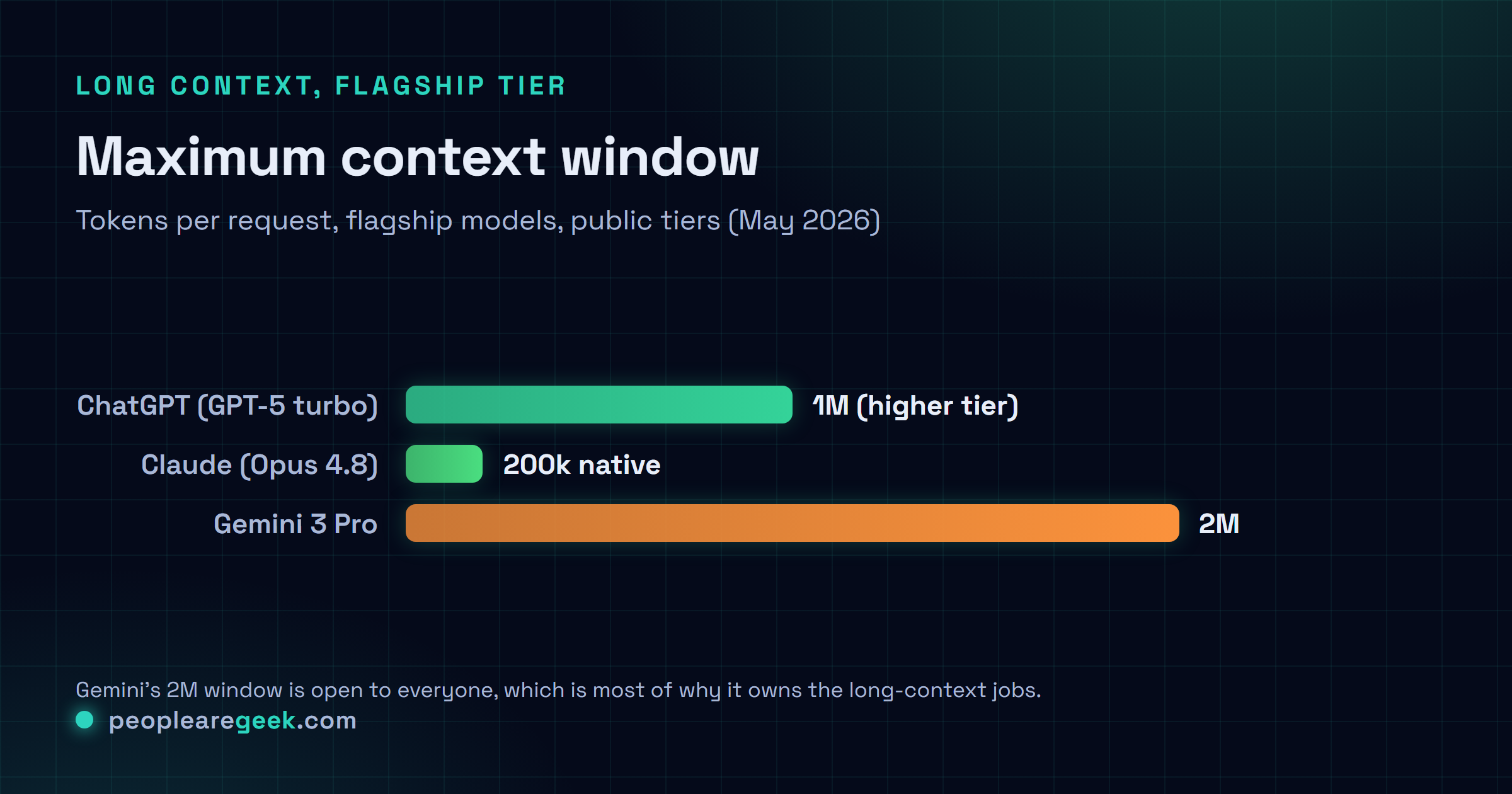
GPT-5 turbo : context window 256k -> 1M (higher tier), partial or full
 coverage depending on tier. Cost ~$2.50 per run at 1M.
Claude Opus 4.8 : 200k context natively, 1M on enterprise request.
 Beyond 200k, retrieval quality degrades.
Gemini 3.0 Pro : 2M context natively, stable cost, excellent
 needle-in-haystack up to 1.5M, degrades after.
Case 8 verdict: long context is Gemini's home turf and nobody's evicted it yet. 2M tokens, open to everyone, not locked behind some enterprise handshake, and the needle-in-a-haystack recall holds up to roughly 1.5M before it starts fraying at the edges. GPT-5 turbo can technically touch 1M these days. The meter spins fast, though, and one run cost me two dollars fifty. Claude is the best quality-per-token you'll find anywhere from zero to 200k, and inside that band I'd take it every time without blinking. Drag it past 200k and you're pulling it out of the zone it was built for, and it shows.
Case 9: Cost per million tokens
Here's the real per-million-token damage, public rates as of May 2026. I split flagships from cheap models on purpose. You don't reach for them on the same jobs, and shoving them into one list just hides where the money actually leaks out.
| Model | Input $/M | Output $/M | Max context |
|---|---|---|---|
| GPT-5 turbo | $5.00 | $15.00 | 256k (1M tier+) |
| GPT-5 mini | $0.40 | $1.60 | 200k |
| Claude Opus 4.8 (standard) | $5.00 | $25.00 | 200k |
| Claude Opus 4.8 (fast mode) | $10.00 | $50.00 | 200k |
| Claude Sonnet 4.6 | $3.00 | $15.00 | 200k |
| Gemini 3.0 Pro | $3.50 | $14.00 | 2M |
| Gemini 3.0 Flash | $0.30 | $1.20 | 1M |
Case 9 verdict: the Opus 4.8 drop on May 28 quietly killed the thing that always made me wince. Old Opus was a 5x tax over Sonnet, so I routed nearly everything to Sonnet and only woke Opus when I had no other option. At five in, twenty-five out standard, Opus 4.8 lands around 1.7x Sonnet 4.6, and that rewrites the math. Sonnet 4.6 is still my default on raw bang-for-buck. But the second tier of work, the stuff I used to leave on Sonnet purely to play it safe, that goes to Opus now and I sleep fine. Down in the cheap seats (bulk generation, classification, extraction) it's Gemini Flash and GPT-5 mini, no argument. And the new Opus 4.8 fast mode (2.5x throughput, ten in, fifty out) costs a third of what the old fast tiers wanted, which is plenty to make me reach for it inside an agent loop where first-token latency is the thing slowly killing me.

Want the number for your actual workload, not some per-million abstraction? It already knows the rates for all six models above, plus Mistral and Cohere if you wire those in.
Case 10: Latency and throughput (TTFT, tokens/sec)
Most of the time latency doesn't matter. People obsess over it anyway. It genuinely matters in two places, and that's about it. One, anything a human waits on live, chat or voice, where they feel every single beat. Two, agent chains, where each step stacks its delay onto the one before, and ten "fast enough" calls add up to a spinner nobody sticks around for.
| Model | Median TTFT | Output tokens/sec |
|---|---|---|
| GPT-5 turbo | 520 ms | ~85 tok/s |
| GPT-5 mini | 280 ms | ~140 tok/s |
| Claude Opus 4.8 (standard) | 620 ms | ~70 tok/s |
| Claude Opus 4.8 (fast mode) | 320 ms | ~175 tok/s |
| Claude Sonnet 4.6 | 420 ms | ~95 tok/s |
| Gemini 3.0 Pro | 580 ms | ~78 tok/s |
| Gemini 3.0 Flash | 180 ms | ~210 tok/s |
| Llama 4 405B via Groq | 120 ms | ~750 tok/s |
Case 10 verdict: anything that streams to a person? Skip the flagships. Flash and mini and Sonnet feel snappier, you won't clock a quality hit on everyday work, and in a chat box "feels fast" is basically the entire game. When I just need a firehose of tokens at the lowest latency money buys, Groq running Llama 4 is still off in its own league at 750 tok/s. One-trick pony, sure. On that trick, though, the rest aren't really in the conversation, and I doubt that changes this quarter.
Overall verdict and decision grid
Came here for me to crown one winner? Sorry. There isn't one, and anyone handing you a single answer in 2026 is selling you something. What I actually do is route. Pick the model per job, by whichever one wins on quality and cost and latency for that one specific thing. The grid below is where I'd start you. Defaults, not gospel. Your traffic mix will shove a few of these cells around, probably within the first week.
| Profile / dominant task | Default choice | Alternative |
|---|---|---|
| Developer (code, refactor) | Claude Sonnet 4.6 | GPT-5 turbo (multi-file) |
| Research / document synthesis | Gemini 3.0 Pro (grounding) | Claude Opus 4.8 (regulated) |
| Content creation (article, narrative) | Claude Opus 4.8 | GPT-5 turbo |
| End-to-end data analysis | GPT-5 turbo (Code Interpreter) | Gemini 3.0 Pro |
| Vision (screenshots, technical OCR) | Claude Opus 4.8 | Gemini 3.0 Pro |
| Audio / transcription / diarization | Gemini 3.0 Pro | GPT-5 plus Whisper |
| Multi-tool agent, function calling | GPT-5 turbo | Claude Sonnet 4.6 |
| Long context (codebase, books) | Gemini 3.0 Pro (2M) | Claude Opus 4.8 (200k quality) |
| Mass generation (classification, extraction) | Gemini 3.0 Flash | GPT-5 mini |
| Streaming UX at very low latency | Groq Llama 4 / Gemini Flash | GPT-5 mini |
What changed at the May 2026 update
I refreshed this on May 29, the morning after Claude Opus 4.8 landed, and three of the changes deserve your attention if you're planning a 2026 stack. The big one for me is the new "fast mode" sitting right beside standard: 2.5x the throughput for a third of what the old fast tiers wanted. In an agent chain, time-to-first-token is often the whole difference between the chain finishing and the user just bailing. It changes which calls I'm willing to make at all. Then there's dynamic workflows, in research preview inside Claude Code, where the agent plans the job, fans out hundreds of parallel sub-agents in one session, then checks its own homework before reporting back. And third, an effort control slider (low, default, extra, max) that's live across the subscription tiers and lets you dial quality against speed without rerouting to a different model entirely. Anthropic's own numbers put agentic coding at 69.2 percent, up from 64.3 on 4.7, and multi-disciplinary reasoning with tools at 57.9, from 54.7. Their benchmarks, so, grain of salt. The jump still tracks with what I've felt using it, for whatever that's worth.
What to watch in late 2026
A few fights are taking shape for the back half of the year. Deep reasoning, the hidden chain-of-thought stuff (o3, Claude Extended Thinking, Gemini Deep Think), now shows up in every flagship, so expect the whole pecking order to get re-litigated on that one axis alone. Native multimodal, where audio and video and image generation all live inside one model, is sprinting at Google with Veo 3 and over at OpenAI with GPT-5 Vision and Sora. And long-running autonomous agents, sessions that run for hours and fire dozens of tools while managing their own memory, are the thing Anthropic and OpenAI keep insisting is the priority. Watch the Q3 announcements; that's where I'd put my money.
Frequently asked questions
Which model should I use if I am starting out and only want one subscription?
One subscription and a quiet life? For chat, a bit of writing, the occasional snippet of code, ChatGPT Plus and Claude Pro feel about the same day to day. Pick whichever UI you actually enjoy looking at. Code is the one place I would split them. If you live in an editor most days, Claude Pro is what I would hand you. And if your work is mostly long documents plus chasing things across the web, I would nudge you toward Gemini Advanced instead, purely for the Google grounding.
Is Claude Opus 4.8 still significantly more expensive than Sonnet 4.6?
Not the way it used to be. Standard Opus 4.8 runs five dollars in, twenty-five out per million tokens against Sonnet 4.6 at three in, fifteen out. Call it 1.7x, where the old Opus tiers stung you a full 5x. So my routing shifted. Sonnet 4.6 handles everyday code and writing. Opus 4.8 standard gets the call the moment a task is worth a small premium for its sharper judgement. And Opus 4.8 fast mode (ten in, fifty out, 2.5x throughput) shows up when I am in an agent loop and latency hurts more than the invoice does.
Will prices keep falling through 2026?
They will, and the pattern has held steady enough that I would put money on it. Today flagships shed maybe thirty percent by year-end and quietly slide down into the Sonnet/Pro tier, while the shiny new flagship lands costing two to three times more. The rule of thumb I plan around: whatever you are running in production is roughly six months old and costs about half the latest flagship. Size your prompt-engineering effort to match. Do not pour three weeks into squeezing a model you will demote by Christmas.
How do production teams that use several models actually route?
Most teams I know either roll their own router in the app or lean on OpenRouter, Portkey or LiteLLM to handle it. The call usually comes down to a handful of things: what kind of task it is (code, vision, long context), how much it actually matters (a customer is staring at the screen versus a batch job nobody watches), and what it is allowed to cost. The bit that surprises people: a cheap little classifier, Gemini Flash or GPT-5 mini, often makes the decision about which expensive model the real request even gets handed to.
Mistral, Llama, DeepSeek: still relevant in 2026?
Absolutely, if you have got the right niche for them. Mistral Large 3 is the one I would raise the moment European data sovereignty or an on-prem deployment hits the table. Llama 4 405B on Groq stays untouchable on latency for streaming UX. And DeepSeek-R3 reasons genuinely well for what it costs, which is close to nothing. None of them flat-out replaces the three American flagships. I still keep every one of them in the toolbox for the jobs they happen to win.