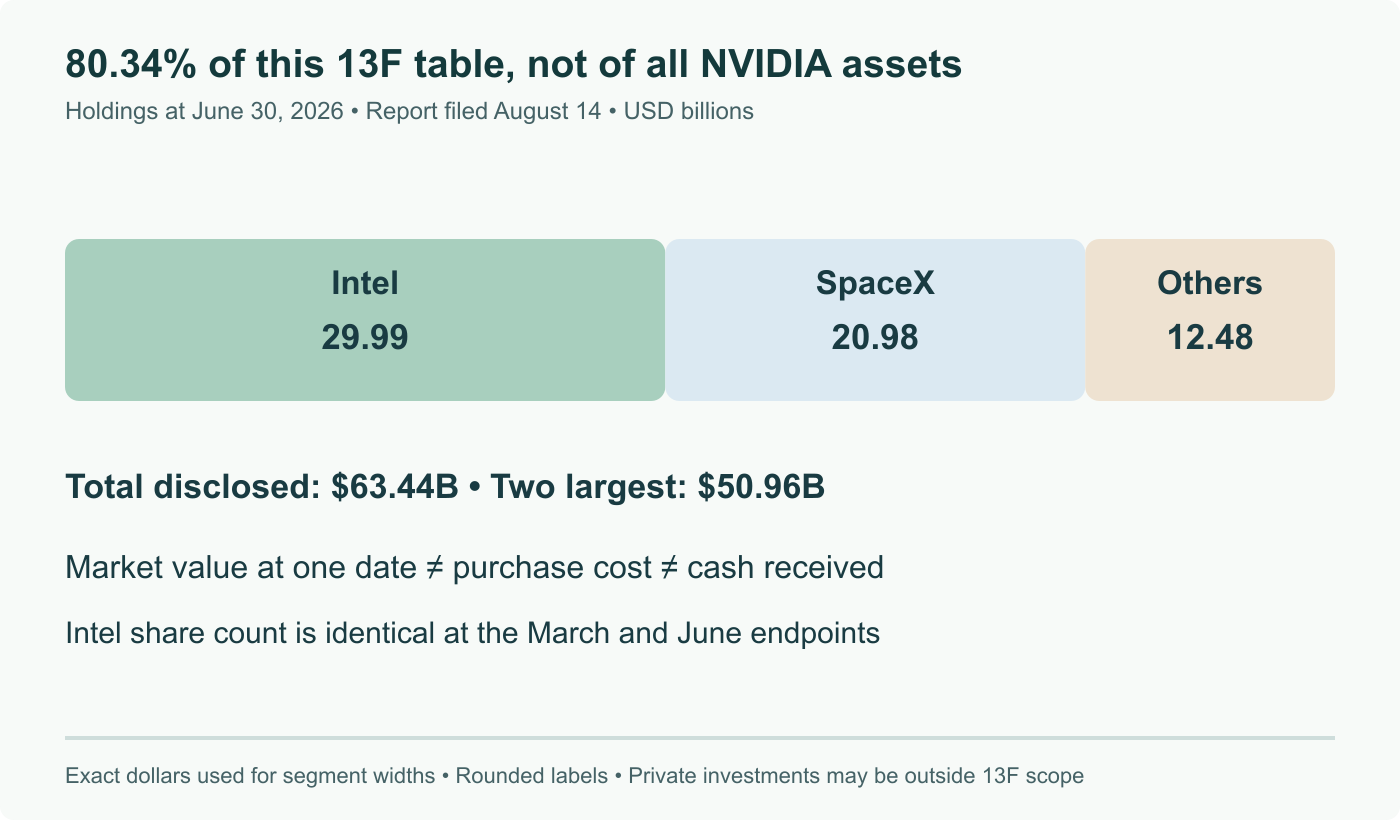
Nvidia filed its quarterly 13F on August 14, 2026, covering positions held at the end of June, and the disclosure is unusually concentrated. Two holdings account for close to eighty percent of the portfolio: about one hundred and twenty two point eight million SpaceX Class A shares worth roughly twenty one billion dollars, and two hundred and fourteen point eight million Intel shares worth about thirty billion, built from a five billion dollar investment. Both companies buy Nvidia silicon. The same day, the guarantee Nvidia had extended to OpenAI was cut to under a hundred and twenty billion dollars.
The short answer
Nvidia's 13F, filed August 14, 2026 for positions held on June 30, discloses about 122.8 million SpaceX Class A shares worth roughly twenty one billion dollars and 214.8 million Intel shares worth about thirty billion, from a five billion dollar cost basis. Together they represent close to eighty percent of the disclosed equity portfolio, and both companies buy Nvidia chips. Smaller holdings include Coherent, Nebius, Nokia and Synopsys. On the same day, the guarantee extended to OpenAI was revised down from about two hundred and fifty billion dollars to under a hundred and twenty.
Quarterly holdings disclosures are dull by construction. They arrive six weeks late, describe a moment that has already passed, and are mostly read by people looking for someone else's ideas. This one is worth ten minutes from anyone who buys servers, because it is not really a portfolio. It is a map of who Nvidia has tied itself to.
What the filing says
The document was submitted on August 14, 2026 and reports positions as they stood on June 30. Two of them dominate.
The first is SpaceX: roughly one hundred and twenty two point eight million Class A shares, worth about twenty one billion dollars at the reporting date, which makes Nvidia the sixth largest holder in the company. The second is Intel: two hundred and fourteen point eight million shares worth approximately thirty billion, grown from an original five billion dollar investment on the back of Intel's foundry recovery.
Together those two sit at close to eighty percent of the disclosed equity portfolio. The remainder is a short list of familiar names in the same supply chain and its adjacent markets: Coherent, Generate Biomedicines, Nebius, Nokia and Synopsys. Coverage of the filing also notes a complete exit from Arm.
One caveat before drawing conclusions from the dollar figures. A 13F is a photograph of June 30, and prices moved afterwards. By the middle of August both large positions were being valued materially below their reported figures. The share counts are the durable part of this disclosure. The valuations are not.
Why a chip company owns its customers
The pattern is straightforward and it is not new. Nvidia's holdings are in companies that buy Nvidia hardware, and the equity is the visible half of a commercial relationship whose other half is allocation, roadmap access and exclusivity.
SpaceX is the clearest case. Nvidia's stake arrived through xAI, which SpaceX absorbed in an all stock deal earlier this year at around one and a quarter trillion dollars, converting an investment in a model lab into an investment in the company that now runs it. Elon Musk has said SpaceX will build its AI data centres exclusively on Vera Rubin hardware. Intel is the other case, where a five billion dollar position became a thirty billion dollar one as its foundry business recovered, in a company whose manufacturing capacity is strategically useful to everyone who depends on leading edge silicon.
The same day brought a revision to a different arrangement. The guarantee Nvidia extended to OpenAI, announced in late July at around two hundred and fifty billion dollars, was cut to under a hundred and twenty billion, with the first phase backstop halved and a decision on the remaining capacity deferred. We wrote about the original two hundred and fifty billion dollar structure when it was announced. The reason for the revision was investor reaction: the stock fell about five percent when the first number appeared.
What this means if you buy hardware rather than shares
Nothing you need to act on this week. Several things worth holding in mind when you plan capacity.
Demand at the top of this market is contractual, not spot. When the biggest buyers are also investees and partners with exclusivity commitments, their orders are scheduled years out and the queue behind them is long. That is the mechanism behind lead times for current generation accelerators, and it does not respond to a purchase order arriving with good intentions.
The corollary is that the previous generation stays useful much longer than vendor messaging implies. Hardware that is two years old still trains and serves models, and it is available now at prices set by a market rather than by an allocation committee. For most workloads that are not frontier training runs, availability beats peak throughput on a specification sheet.
Second sourcing keeps earning its cost. Not because any single supplier is unreliable, but because concentration of this degree means the terms you are offered are downstream of relationships you are not part of. Keeping one workload running on alternative silicon, even at a performance penalty, preserves the option to move and gives you a real number to negotiate with.
The wider pattern
Set the pieces side by side. A chip vendor holds eighty percent of its disclosed portfolio in two customers. It guarantees a third customer's financing, then halves the guarantee when shareholders object. It has already lined up hundreds of billions in financing for the buildout that its own customers are undertaking.
None of that is improper, and all of it is disclosed. It does describe a market where capital, supply and demand are increasingly the same people, and where the ordinary signals a buyer relies on, price and availability, are set inside those relationships rather than by them. The useful posture for a technical team is neither alarm nor indifference. It is to plan for capacity being rationed, treat exclusive roadmaps as advertising until hardware ships, and keep enough flexibility that you are not the last name on someone else's allocation list.
Sources and further reading
- Nvidia has $21 billion SpaceX stake, $30 billion in Intel shares, Bloomberg, August 14, 2026
- Nvidia has $21 billion SpaceX stake, $30 billion in Intel shares, Fortune, August 15, 2026
- Nvidia turns $5B Intel stock bet into $30B windfall, filing reveals new $21B SpaceX stake and complete exit from Arm, Tom's Hardware, August 2026
- Nvidia OpenAI backstop halved as 13F reveals its stakes, The Next Web, August 2026
- Nvidia Discloses $50B Equity Stake in SpaceX and Intel, Tech Times, August 15, 2026
Frequently asked questions
What is a 13F and why does this one matter?
A 13F is the quarterly disclosure large institutional managers file with the Securities and Exchange Commission listing their holdings in exchange traded securities. It is backward looking by design: this filing, submitted on August 14, 2026, describes positions as they stood on June 30. It matters here because Nvidia is not a fund. It is a chip maker, and the filing shows its balance sheet concentrated in two companies that buy its products, which is a supply chain fact dressed up as a financial one.
What are the actual positions?
About one hundred and twenty two point eight million SpaceX Class A shares, valued at roughly twenty one billion dollars at the end of June, making Nvidia the sixth largest holder. And two hundred and fourteen point eight million Intel shares worth approximately thirty billion at the same date, grown from a five billion dollar investment. Smaller positions include Coherent, Generate Biomedicines, Nebius, Nokia and Synopsys. Market values move after the reporting date, and both large positions were reported lower by mid August than they were on June 30.
How did Nvidia end up owning part of SpaceX?
Through xAI. Nvidia had invested in the model company, and SpaceX absorbed xAI in an all stock transaction earlier in 2026 at a valuation around one and a quarter trillion dollars. Investors in the smaller company received shares in the larger one, which is how a chip vendor's AI investment became a stake in a launch business. The strategic logic survived the conversion intact, because SpaceX is building large AI data centres and Elon Musk has stated they will be built on Nvidia's Vera Rubin generation.
What changed with the OpenAI backstop?
It was roughly halved. The guarantee announced in late July was around two hundred and fifty billion dollars, and on August 14 it was revised to under a hundred and twenty billion, with the initial phase backstop reduced to about half and the decision on the remaining capacity deferred. The trigger was investor discomfort rather than a technical problem: Nvidia shares fell about five percent after the original figure was published. Financing structures that large are now being negotiated in public, which is new.
Does any of this affect what a buyer of servers actually pays?
Indirectly, and worth understanding rather than acting on. Equity positions and exclusivity commitments concentrate demand signals: when the largest buyers are also investees, allocation decisions and roadmap priorities follow those relationships, and generic buyers sit further down the queue. The practical consequences are the familiar ones. Lead times for the newest accelerators stay long, the previous generation stays useful longer than vendor messaging suggests, and second sourcing remains worth the effort even when it costs a few points of peak performance.