Firefox 155 adds Happy Eyeballs v3 on some platforms and QUIC version negotiation. Racing connection candidates can reduce delays from an unreachable path, but the result depends on the browser platform, DNS answers and network.
What Firefox actually ships
Mozilla’s developer release notes date Firefox 155 to September 1 and explicitly limit Happy Eyeballs v3 support to some platforms. They also confirm negotiation of QUIC v2 for HTTP/3. This is not evidence that every Firefox installation takes exactly the same connection path.
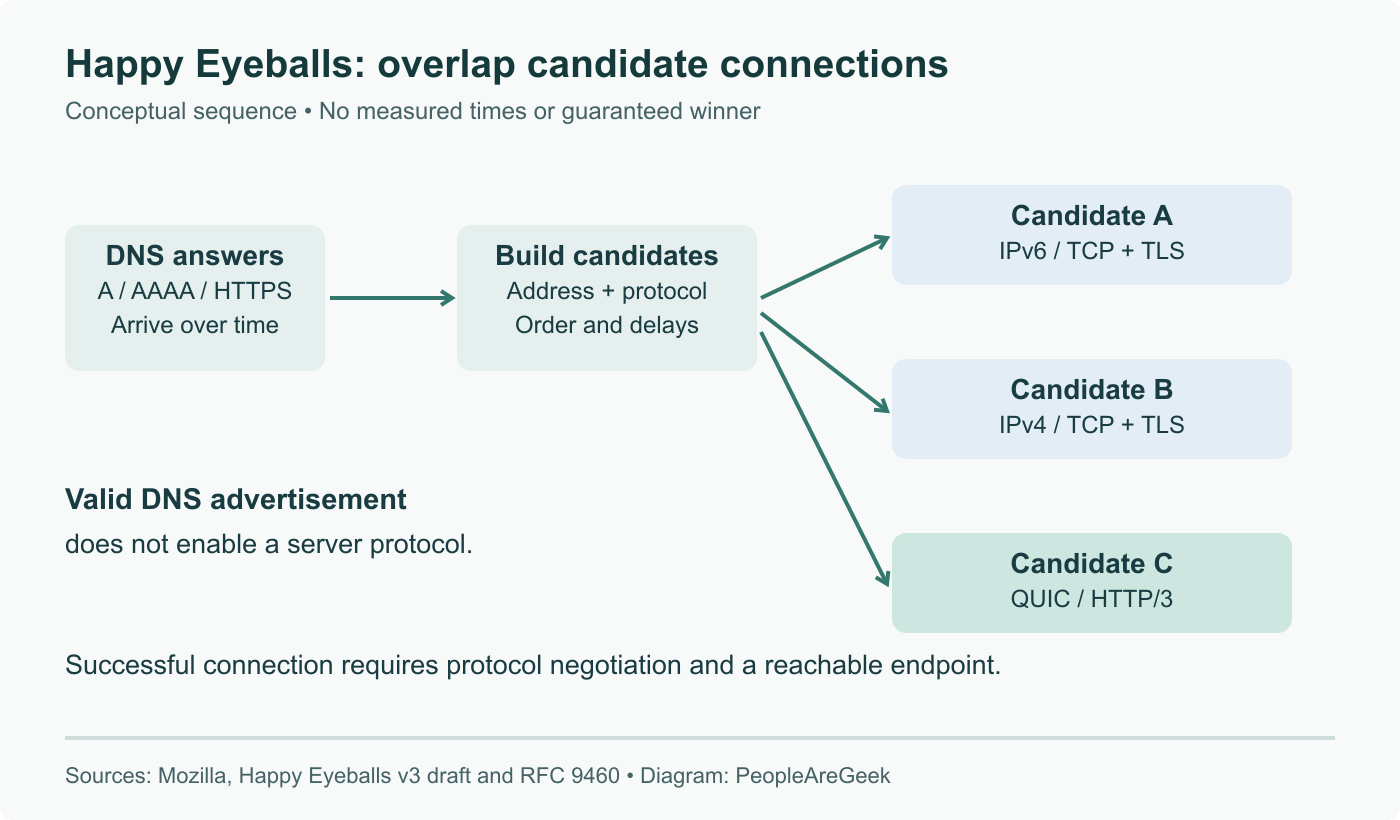
The IETF Happy Eyeballs v3 document remains a draft. It considers DNS answers, application protocols and address families when organizing candidate connections. Attempts can overlap with controlled delays; they are not necessarily all launched at once. The diagram is a possible race, without measured timings or an implied winning protocol.
DNS can advertise a service before the HTTP response
HTTPS resource records, specified in RFC 9460, can advertise supported application protocols. An illustrative zone entry for a service that really supports HTTP/3 and HTTP/2 is:
example.com. 300 IN HTTPS 1 . alpn="h3,h2"This is syntax for a fictional domain, not a change to apply blindly. Advertising h3 does not enable QUIC at the server. Confirm that the edge supports it, certificates cover the hostname, and UDP 443 reaches the service. Address hints are optional and must remain consistent with the intended endpoints if supplied.
A cached Alt-Svc entry can already inform a returning client about HTTP/3. The benefit of HTTPS records is therefore not a universal fixed round-trip saving on every navigation.
QUIC v2 has a different purpose
RFC 9369 changes wire-level details to exercise protocol version diversity and resist ossification. A version number is not a throughput benchmark. Measure connection setup on cold and warm caches, working and impaired IPv6, and networks that permit or block UDP. Keep successful fallback in the test: a fast QUIC path on one network is not enough to validate public availability.
For an operator, the actionable sequence is to verify the current edge configuration, inspect the DNS record actually returned, then compare browser traces across those conditions. We have not measured a site-wide performance gain from Firefox 155.
Sources
- Mozilla: Firefox 155
- IETF Happy Eyeballs v3 draft
- RFC 9460: SVCB and HTTPS records
- RFC 9369: QUIC v2
Clarified platform-limited rollout, IETF draft status and HTTPS-record requirements; removed guaranteed latency and speed claims.