Pangolin 1.22 places identity and usage controls between AI clients and model providers. Its spending limits are based on recorded usage, not a guarantee of an exact final invoice. That detail matters when several agents share a gateway.
Separate client identity from the provider secret
The 24 August release introduces public gateways authenticated by virtual keys and private gateways authenticated through the connected Pangolin client. Cloud providers and self-hosted endpoints can share this access layer. Provider credentials stay on the gateway side; public does not mean anonymous.
It also brings browser SSH, RDP and VNC resources, plus private SSH and HTTPS, to Community Edition. That does not imply that every analytics or transcript feature has the same edition availability.
A budget can be exceeded by the request it admits
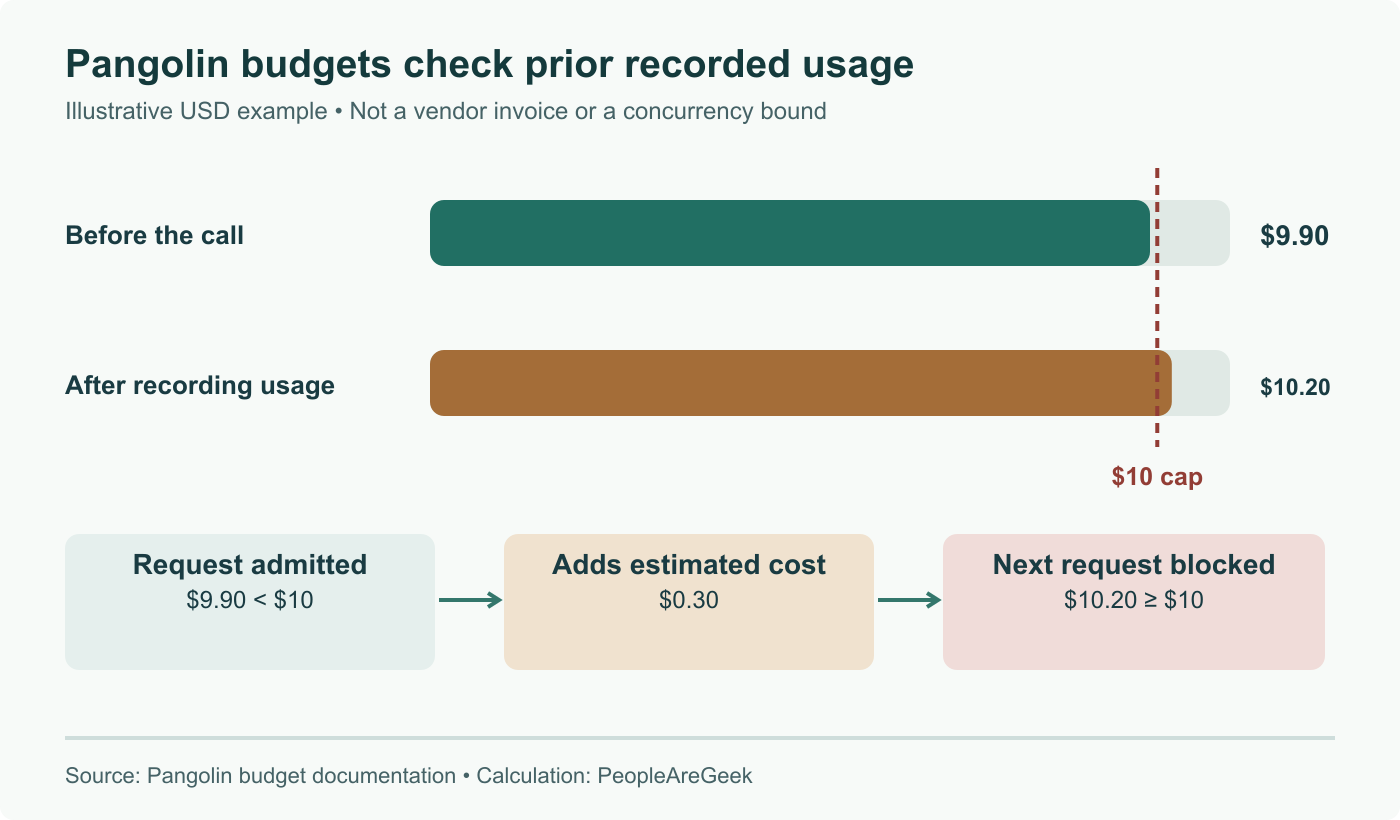
The budget documentation explicitly uses earlier recorded usage to decide whether to forward a request. A request admitted below the limit can finish above it. Costs use catalog estimates; a model without a catalog match has no USD amount, though its token usage can still count toward token budgets. Daily limits cover a trailing 24 hours rather than resetting at midnight.
Consider an illustrative $10 cap with $9.90 already recorded. A request admitted now that records $0.30 afterward brings usage to $10.20. The following request is blocked while that usage remains in the matching window. This is a calculation from the documented rule, not an observed test or a claim about the maximum overshoot under concurrency.
For a deployment, test a known-priced model, an unpriced model and overlapping calls with tiny disposable quotas. Compare gateway estimates with the provider’s actual usage records. Keep a provider-side limit where the provider supports one; a proxy estimate should not be treated as the billing authority.
Decide deliberately whether to retain prompts
Session logs are available in Cloud and self-hosted Enterprise. Their default retention is zero days, leaving transcript logging off; a positive retention enables it. Usage analytics records are separate, and changing transcript retention does not delete those usage records.
Before enabling transcripts, decide which administrators can read them and how long the content is needed. Agent requests may contain source code, internal URLs or customer text. Reducing the spread of provider keys does not make the request contents non-sensitive.
Watch the publisher’s walkthrough
The video below is embedded in Pangolin’s release announcement and can help locate the gateway and provider controls. It is a vendor presentation, not an independent assessment.
Pangolin 1.22 release walkthrough
Official presentation from Pangolin. The YouTube player loads only when you request it.
Watch on YouTube · Maintainer’s announcement. Loading the player connects to YouTube, which applies its own privacy policy.
After configuring a client, send a harmless identifiable test prompt and confirm that it appears in the expected usage scope. Then revoke its test access and check that the same path fails. This verifies the intended route rather than assuming a saved base URL changed every tool.
Sources
- Pangolin 1.22 announcement
- Budgets: estimates, windows and enforcement
- Session logs: editions and retention
Checked release and budget/log documentation; clarified overshoot, unpriced models and edition-specific transcript retention; added the vendor’s release video behind click-to-load.