pfSense vs OPNsense for home networks comes down to four things in 2026, because on features the two have basically caught up to each other. Both are FreeBSD firewalls that split off the same family tree about a decade back. pfSense, run by Netgate, is the stable one with the huge installed base. OPNsense, run by Deciso, is the one with the slick reactive UI, updates every two weeks, and an inline IDS baked right in. I have had both on the exact same N100 mini-PC, both saturate my gigabit fibre, both do WireGuard and OpenVPN without complaint. So the real decision is about update frequency, how the UI feels, the plugin shelf, and whether you will ever wander past plain NAT and firewall rules. I landed somewhere. I will tell you where.
The short answer
Both saturate gigabit on the same N100 mini-PC and both do WireGuard and OpenVPN without complaint, so the 2026 pick is not about raw features. pfSense CE is the set-and-forget choice with the deepest docs and a Netgate box you can ship to your dad. OPNsense gives you the modern reactive UI, updates every fortnight, a public Git tree, and inline Suricata in the box. OPNsense is what I keep on my own edge.
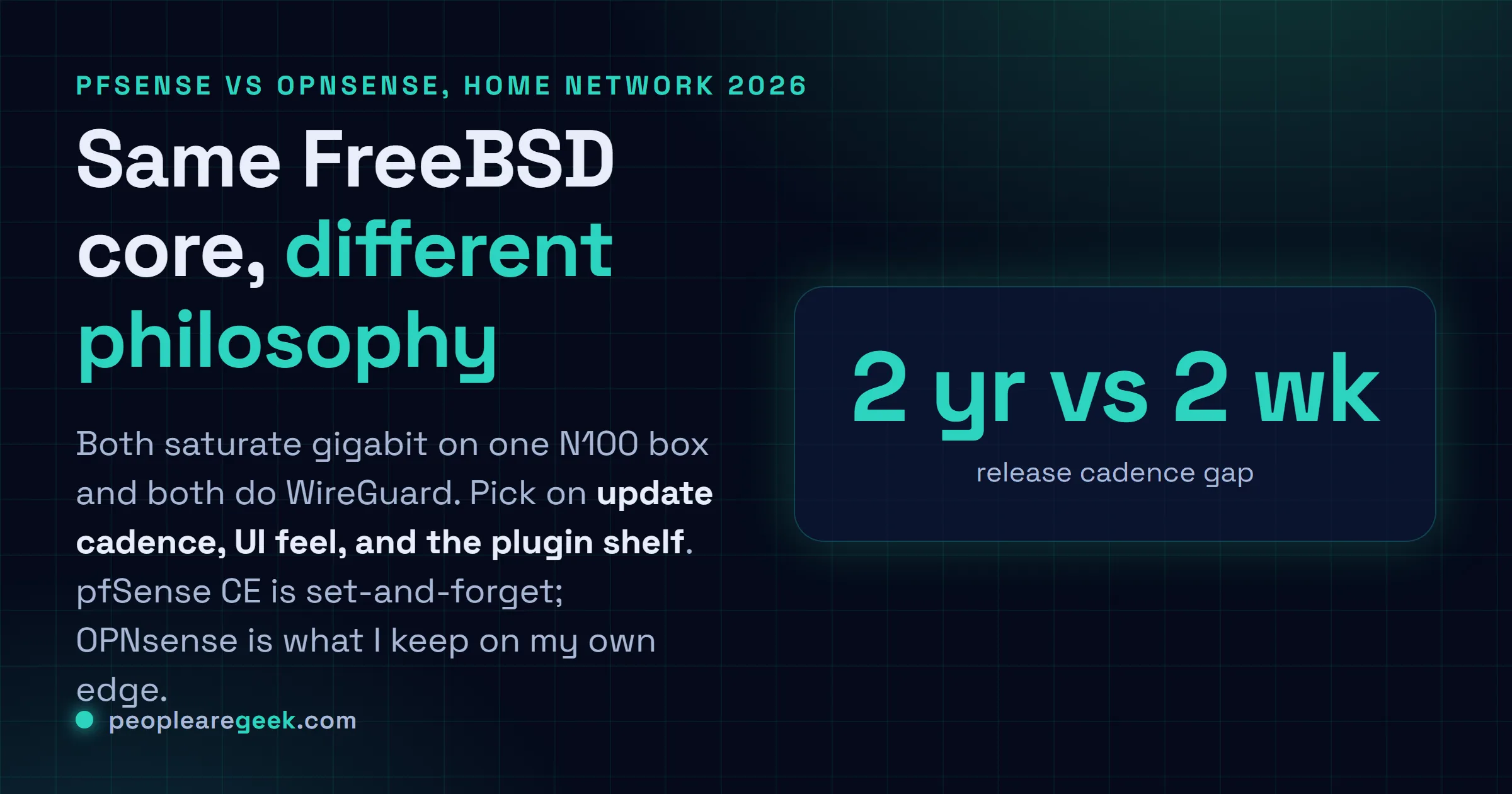
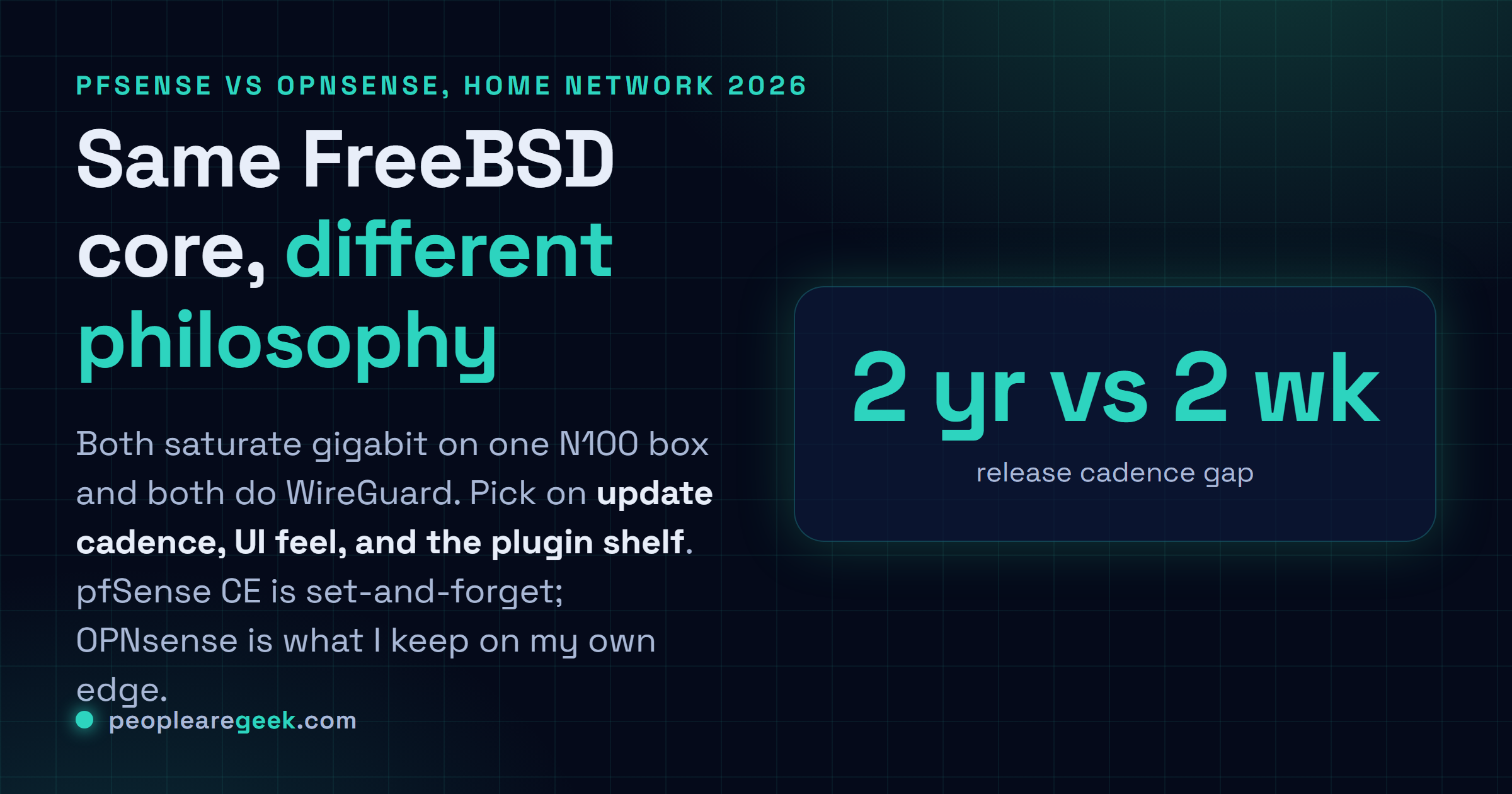
Both of these have lived on my rack for years. And I still get asked which one to pick, roughly once a week. So, the honest version. Both are FreeBSD firewalls that split off the same family tree about a decade back. pfSense run by Netgate, is the stable one. Hardware boxes, an installed base the size of a small country. OPNsense run by Deciso, is the one with the slick reactive UI, the updates every two weeks, an inline IDS baked right in. I've had both on the exact same N100 mini-PC. Both saturate my gigabit fibre without noticing, both do WireGuard and OpenVPN without complaint. Which means the 2026 decision isn't really about features anymore. They've caught up to each other there. It's about how often you want updates, how the UI makes you feel, what's sitting on the plugin shelf, and whether you'll ever wander past plain NAT and DHCP and firewall rules. I landed somewhere. I'll tell you where.
Shared history, divergent destinies
Both trace back to m0n0wall Manuel Kasper's tiny FreeBSD firewall from 2003. pfSense forked off it in 2004. Then 2015, OPNsense forked off pfSense. Not amicably either. It was a falling-out over commit access and how open the thing really was, and you can still feel the chill in old forum threads. Under the hood they're cut from the same cloth. PHP front-end, pf as the packet filter, FreeBSD kernel. What's genuinely different is who's holding the wheel. Netgate runs pfSense as a company: a free Community Edition (CE), then a paid Plus tier that usually gets the new toys first. Deciso runs OPNsense as one open project. One edition, full stop. The "business edition" is just a support contract bolted on top, same code, same binaries. You're only ever paying for someone to pick up the phone.
The full head-to-head table
| Dimension | pfSense CE 2.7 | OPNsense 24.7 |
|---|---|---|
| OS base | FreeBSD 14 | FreeBSD 14 (HardenedBSD until 22.1) |
| UI framework | Bootstrap 4 | Phalcon + custom theme |
| Dark mode | Plugin (pfBlockerNG theme) | Built-in |
| Release cadence | ~2 years major, monthly patch | 2 majors / year + biweekly stable |
| Update transparency | Changelog only | Live commit feed, signed Git tree |
| WireGuard | Kernel module since 2.7.0 | Kernel module since 21.7 |
| Inline IDS | Snort or Suricata package | Suricata built-in (Sensei plugin for Netify) |
| Plugin count | ~70 | ~200 |
| API | REST in Plus only | REST/JSON included |
| Backup | Encrypted XML, manual | Encrypted XML + AutoConfigBackup free |
| Appliances | Netgate boxes (EUR $$$) | Deciso DEC650 / DEC700 (EUR EUR) |
| License | Apache 2.0 | BSD 2-clause |
UI and daily-driver experience
Log into pfSense having last touched it five years ago and you'd feel right at home. Dense. Businesslike. Nothing's moved. Bootstrap 4 underneath, mostly old-school full-page reloads. Every settings page sits at its own URL, which, honestly, I love. I can bookmark it, Ctrl-F it, and the page never ambushes me with some half-loaded JavaScript state. The downside is purely cosmetic. Tables look a bit dated, the dashboard widgets just kind of sit there, and on my 4K monitor the default theme leaves acres of dead space.
OPNsense went the other way entirely. They rebuilt the front-end on Phalcon, then in 23.7 leaned hard into a reactive, client-side feel. Dashboards update live, the lists virtualise so my 5 000-rule firewall doesn't choke when I scroll, dark mode's just there. No plugin, no theme hunting. What does that cost you? Less than you'd think. Once in a while I have to double-click something pfSense would've caught on the first try, and there's a small JS bundle that adds maybe 200 ms to first paint on a cold cache. I take that trade every single day.
Release cadence and update transparency
Read this part if you skip everything else. This is where the two actually diverge, and for me it's what settles the whole argument.
- pfSense CE drops a major version every 18 to 24 months, give or take, with patches sprinkled between. Plus gets the new features first. Netgate hasn't hidden that; they've said outright that some CE updates trail Plus by months. You get changelogs, sure. But the Git tree is mostly a mirror of a private repo, pushed out in batches. You're watching from the cheap seats.
- OPNsense ships two majors a year, pinned to January and July, plus a stable release roughly every fortnight. And the Git tree is the project. Every commit, every signed tag, every advisory, right out in the open where you can actually read it.
Now, if your firewall is basically furniture (set it up, forget it, don't touch it for three years), then the slow cadence is genuinely a plus, and I won't argue the point. That's just not how I run mine. When a nasty CVE lands upstream I want the fix in days, not next quarter, and OPNsense gets it to me. Maybe I'm more twitchy about patching than I need to be, I'll admit that. But it's the single biggest reason OPNsense is what I keep on my own edge.
Plugins and ecosystem
OPNsense lists around 200 official packages, pfSense about 70. Don't read too much into that gap. It's nowhere near as lopsided as it sounds. pfSense tends to cram more into each package, and a big slice of the OPNsense list is little single-job plugins. In practice the stuff you'll actually install lines up almost one-to-one. pfBlockerNG on pfSense. Zenarmor and Sensei on OPNsense. Then the usual suspects living on both, HAProxy, Squid, Tailscale, Caddy. WireGuard's first-class on both now, and OpenVPN client and server both just work either way.

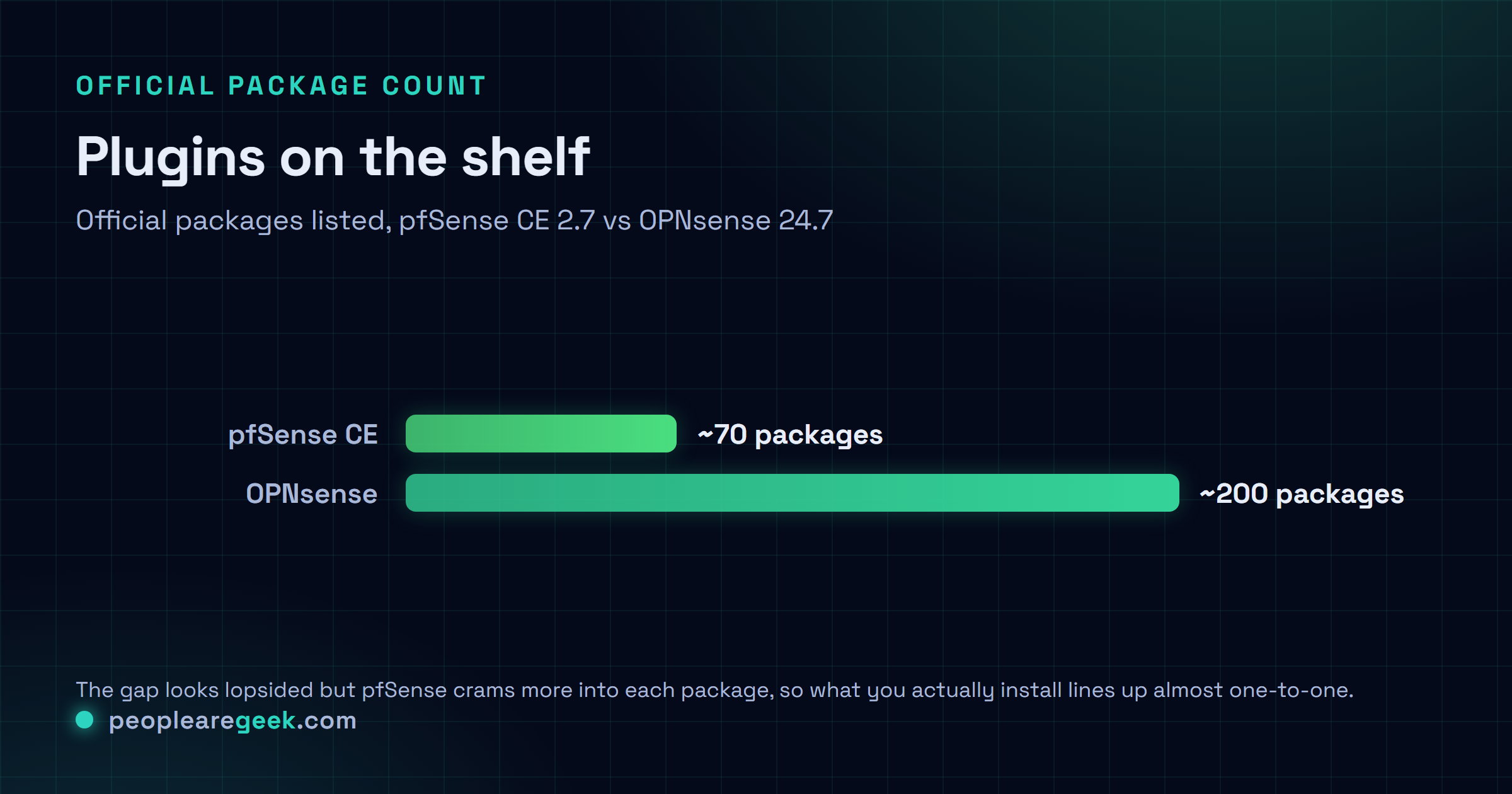
Where OPNsense pulls ahead is the newer packages: os-acme-client for Let's Encrypt, os-frr when you need real routing, os-wireguard with a UI that's genuinely pleasant to sit in. Where pfSense still has the edge is depth. pfBlockerNG has knobs for days, and Snort gives you more to tune. Funny thing, both of those were born on pfSense and got ported over to OPNsense later. Home turf advantage.
Performance on prosumer hardware
I ran both on the same Intel N100 mini-PC, 8 GB of RAM, just swapping the boot drive between them so nothing else moved. Here's what the numbers said:
| Workload | pfSense CE 2.7 | OPNsense 24.7 |
|---|---|---|
| WAN throughput 1 Gbps NAT only | 940 Mbps, 8 % CPU | 940 Mbps, 9 % CPU |
| WireGuard tunnel saturated | 820 Mbps, 38 % CPU | 790 Mbps, 41 % CPU |
| WireGuard + Suricata inline (default ruleset) | 520 Mbps, 71 % CPU | 490 Mbps, 73 % CPU |
| Cold boot to ready | 72 s | 78 s |
Look at those numbers. A rounding error apart, the lot of them. So if anyone tells you one of these is meaningfully faster than the other on prosumer hardware in 2026, go check what they're trying to sell you. The silicon couldn't care less which logo sits on the login page.
Hardware support and appliances
They run on the same kind of hardware. Any x86_64 box with two NICs or more, which covers basically everything sitting in a homelab. The differences only surface at the margins. Netgate sells its own boxes (1100, 2100, 4100, 6100, 8200) tuned for pfSense Plus, and yeah, CE runs on them perfectly well too. Deciso sells its own boxes (DEC650, DEC700, DEC840, DEC2700) tuned for OPNsense, crypto offload and all. On ARM, both handle ARM64 in 2026, but I'd give pfSense Plus the nod here. Its official ARM image is the more polished of the two, or at least it was last I checked. For DIY rigs, though? A mini-PC, an old thin client you rescued from a skip, both just go. pfSense publishes a longer hardware compatibility list, but in real life every common Intel and Realtek NIC I've thrown at either one worked first try.
The verdict, per use case
- Want set-and-forget stability and a Netgate box you can ship to your dad and never think about again? Go pfSense. This is the one case where I'd reach for it without a second's hesitation.
- Want the modern UI, updates every fortnight, a public Git tree you can actually grep? OPNsense. It's what's on my own edge.
- Want inline IDS without bolting on extra packages? OPNsense. Already in the box.
- Want the deepest docs and the biggest forum to dig you out of a hole at midnight? pfSense still takes that one.
- Standing up a little managed-service stack you'll automate? OPNsense, purely for the REST API you don't pay extra to unlock.
- Twitchy about one company holding the keys? OPNsense. One edition, no Plus tier behind a paywall, nothing to second-guess at 2am.
- Already happy on pfSense Plus and you know the docs cold? Then stay put. I mean it. The migration headache isn't worth the little you'd gain.
Sources and further reading
Frequently asked questions
Can I migrate from pfSense to OPNsense by restoring the XML config?
Partly, yeah. OPNsense has a pfSense config importer and it's decent, it'll bring over your interfaces, the basic firewall rules, NAT, DHCP, OpenVPN. What it won't touch is your plugins. pfBlockerNG, Snort, all of it, you're reinstalling and reconfiguring by hand. When I moved a firewall I'd been fiddling with for ages, it ate the better part of an afternoon. So block out half a day. You probably won't need all of it, but you won't get caught out either.
Is pfSense going commercial-only?
No. And people keep expecting it to. Netgate has said again and again that CE stays free and open. The real split isn't free-versus-paid going away, it's speed. Plus gets the features first, CE gets them later. That's the whole deal. But I'll be straight with you, if that arrangement makes you uneasy, OPNsense's one-edition-for-everyone model is just cleaner to reason about. No paywall to wonder about.
Which is better for a 10 Gbps WAN?
Both hit 10 Gbps if you hand them the hardware for it, think six-core Xeon-D class with an Intel X710. On Netgate's higher-end boxes pfSense has slightly tighter Intel QAT crypto offload, but OPNsense runs that same silicon just fine. For a DIY 10 Gbps build the gap is basically noise. So don't agonise. Pick on the UI and the update cadence, that's the part you'll actually feel day to day.
What about VyOS, RouterOS, or OpenWrt?
Honestly? Different sport. VyOS is CLI-first and Linux-based, I file it under Juniper stand-in, not home firewall. MikroTik RouterOS is fantastic on MikroTik's own gear and pretty pointless on an x86 box. OpenWrt is built for consumer Wi-Fi routers, not an x86 firewall appliance. So if it's an x86 home firewall you're after in 2026, pfSense versus OPNsense really is the comparison that matters. The rest are answering a different question entirely.
Does OPNsense's biweekly cadence break things?
Rarely, in my experience. The stable releases are tested, it's the major version jumps that bite, not the fortnightly ones. Realistically you're looking at the odd bug you have to roll back from, not some production-killer every two weeks. And there's one habit that makes the whole worry evaporate: take the encrypted config snapshot before each update. Something acts up, rollback's one command, you're back where you started. I've done it half-asleep more than once.