Proxmox vs ESXi vs Hyper-V in 2026 is really a cost and lock-in question, not a technical one. I run all three: Proxmox on the homelab cluster, ESXi on a box at work I am not allowed to touch the licensing on, and Hyper-V on a Windows Server doing Active Directory. So when someone asks which hypervisor to pick now, I do not reach for a spec sheet. Broadcom bought VMware, ripped up the pricing, killed the free ESXi tier, and shoved a generation of homelabbers and small shops out the door. Most landed on Proxmox. All three are solid type 1 hypervisors. The question is cost, lock in, and which world you already live in.
The short answer
All three are solid type 1 hypervisors, so the 2026 choice is cost and lock in, not raw technology. Proxmox is free, clusters out of the box, ships ZFS and Ceph, and backs up with the free Proxmox Backup Server. ESXi is subscription only and per core now, worth it only if you are already deep in vSphere. Hyper-V is free if you already pay for Windows and you live in the Microsoft stack.
I run all three. Proxmox on the homelab cluster, ESXi on a box at work that I'm not allowed to touch the licensing on, and Hyper-V on a Windows Server that does Active Directory and a couple of VMs on the side. So when someone asks me which hypervisor to pick in 2026, I don't reach for a spec sheet. I think about what actually happened over the last two years. And what happened is this: Broadcom bought VMware, ripped up the pricing, killed the free ESXi tier, and shoved a whole generation of homelabbers and small shops out the door. Most of them landed on Proxmox. That's not a hot take, that's just where the traffic went. So the 2026 question isn't really "which is technically best." All three are solid type 1 hypervisors that'll happily run your VMs. The question is cost, lock in, and which world you already live in. Let me walk you through where each one fits now, honestly, including the parts that'll annoy you.
The Broadcom story, because it changed everything
You can't talk about hypervisors in 2026 without this. Broadcom closed the VMware acquisition in late 2023, and within months the whole model flipped. Perpetual licenses? Gone, moved to subscription only. The free ESXi hypervisor, the one homelabbers had run for a decade? Discontinued, then partly walked back, then fenced off in ways nobody trusts anymore. Partner programs got culled. Minimum core counts went up. For a lot of small shops the renewal quote landed at three or four times the old number, and that's not me exaggerating, that was a very common story across the forums through 2024 and 2025.
So people left. In droves. And the place most of them went was Proxmox VE, because it's free, it's open, it does clustering and ZFS out of the box, and it doesn't have a sales rep attached. Honestly, Broadcom did more for Proxmox adoption in eighteen months than the Proxmox team could've managed in five years of marketing. Hyper-V picked up some of the Windows-heavy refugees too. The point is, the landscape in 2026 is downstream of that one acquisition. Keep it in mind for everything below.
The full head-to-head table
| Dimension | Proxmox VE 8 | VMware ESXi 8 | Hyper-V (2025) |
|---|---|---|---|
| Cost / licensing | Free, optional paid support subscription | Subscription only, per core | Free with Windows Server / Pro license |
| Hypervisor type | Type 1, KVM based | Type 1, bare metal | Type 1, runs under Windows parent |
| Management UX | Built-in web UI, no extra server | vCenter for fleet (paid) | Windows Admin Center / Hyper-V Manager |
| Clustering / HA | Built in, free, no license gate | vSphere HA, paid tier | Failover Clustering (Datacenter) |
| Storage | ZFS, Ceph, LVM included | vSAN (paid add-on), VMFS | Storage Spaces, ReFS, SMB3 |
| Backup ecosystem | Proxmox Backup Server, free | Veeam and others, third party | Veeam, Windows Server Backup, DPM |
| Hardware passthrough | PCIe / GPU passthrough, mature | DirectPath I/O, well supported | DDA, works but fussier |
| Containers | LXC native, plus Docker in a VM | None native (Tanzu is separate) | Windows Containers, WSL2 |
| Learning curve | Moderate, Linux-flavored | Gentle UI, steep licensing maze | Easy if you know Windows |
| License | AGPLv3, open source | Proprietary | Proprietary, bundled |
Proxmox VE: the open-source winner
Proxmox is a Debian box with KVM and LXC stapled on, a clean web UI bolted in front, and clustering that just works without anyone asking for a credit card. That's the elevator pitch, and it undersells it. The reason it won the post-Broadcom exodus is that everything VMware charges extra for, Proxmox ships in the base install. Live migration. High availability across a cluster. ZFS with snapshots and replication. Ceph if you want hyperconverged storage. None of it is behind a tier.
The backup story is the part that surprised me most. Proxmox Backup Server does deduplicated, incremental, encrypted backups of your VMs and containers, and it's free. Set it up on a second box, point your cluster at it, done. For homelab and small business that one piece alone replaces a Veeam line item. Where Proxmox makes you work a little harder is the Linux underneath. If a ZFS pool gets weird or a cluster quorum goes sideways, you're in a shell reading logs, not clicking a wizard. That's the trade. I think it's a fair one, but I won't pretend it's as hand-holdy as vCenter on a good day. LXC containers are the other quiet superpower here. Need a lightweight service? Spin a container in seconds instead of a full VM. Nothing else in this comparison does that natively.
VMware ESXi: still powerful, now expensive
Let me be clear about something. ESXi is a genuinely excellent hypervisor. The technology didn't get worse when Broadcom showed up. vMotion is still silky, the driver and hardware compatibility list is still the broadest in the business, and in a big enterprise with a VMware-certified team and a SAN already humming, vSphere is a beautifully integrated machine. If that's your world, you probably know it cold.
The problem is everything around the technology. It's subscription only now, priced per core with minimums that punish small deployments. The free tier that onboarded a generation of admins is effectively gone. So the honest 2026 position is narrow: ESXi makes sense if you're already locked into vSphere, your team is trained on it, you've got enterprise support contracts, and the switching cost outweighs the renewal pain. For anyone else, especially anyone starting fresh, the licensing alone is a reason to look elsewhere. I'm not saying that to be edgy. I'm saying it because I watched the renewal quotes land and watched people leave. If you're checking what ESXi even is, our VMware ESXi hub has the deeper background.
Hyper-V: free if you're already Windows
Hyper-V is Microsoft's type 1 hypervisor, and it's been quietly competent for years. Here's the thing people miss: it's a role you flip on inside Windows Server (or Windows Pro), so if you already pay for Windows, you already have it. No separate hypervisor bill. For a shop that's deep in the Microsoft stack, Active Directory, Windows Admin Center, System Center, that integration is the whole selling point. Managing VMs from the same console you manage everything else is genuinely nice.
Two honest caveats. First, the standalone Hyper-V Server product, the free dedicated SKU, was discontinued, so you can't get a no-cost bare hypervisor from Microsoft the way you used to. You're running the role on a licensed Windows install now. Second, Hyper-V is happiest managing Windows guests. It runs Linux fine, and modern integration services are solid, but the tooling and the community gravity point at Windows. If your whole estate is Windows, that's a non-issue and Hyper-V is a smart, cheap default. If you're a Linux shop, it'll feel like swimming upstream. Our Hyper-V hub goes deeper, and if you want a hands-on project, the CTF lab on Hyper-V walkthrough is a good way to actually feel the workflow.
How they compare, criterion by criterion
Cost and licensing
This is the 2026 headline, full stop. Proxmox is free, with an optional paid support subscription if you want someone to call. Hyper-V is free in the sense that it rides on a Windows license you're probably already buying. ESXi is subscription only, per core, with floors that hurt small deployments. If cost is anywhere near the top of your list, ESXi is out and it's not close.
Hypervisor type and performance
All three are type 1. Proxmox sits on KVM, which is the same battle-tested kernel virtualization that runs huge chunks of the public cloud. ESXi is the classic purpose-built bare-metal design. Hyper-V is type 1 too, though it boots Windows as a privileged parent partition, which feels different but performs well. Raw performance between them is close enough that it rarely decides anything. Pick on the other rows.
Management, clustering, and storage
Proxmox gives you a real web UI and free clustering in the base product. ESXi's serious fleet management lives in vCenter, which is a paid, separate thing. Hyper-V leans on Windows Admin Center and Failover Clustering, clean if you're a Windows admin. On storage, Proxmox bundles ZFS and Ceph for free, ESXi puts vSAN behind a paid add-on, and Hyper-V uses Storage Spaces. The pattern repeats: Proxmox includes, VMware charges, Microsoft bundles into Windows.
Backup, passthrough, containers
Backup is a real differentiator. Proxmox Backup Server is free and purpose-built. ESXi and Hyper-V both lean on Veeam, which is excellent but a separate purchase. GPU and PCIe passthrough is mature on Proxmox and ESXi, a bit fussier on Hyper-V's DDA. And containers: only Proxmox does LXC natively, which for a homelab is a real day-to-day convenience.

The verdict, per use case
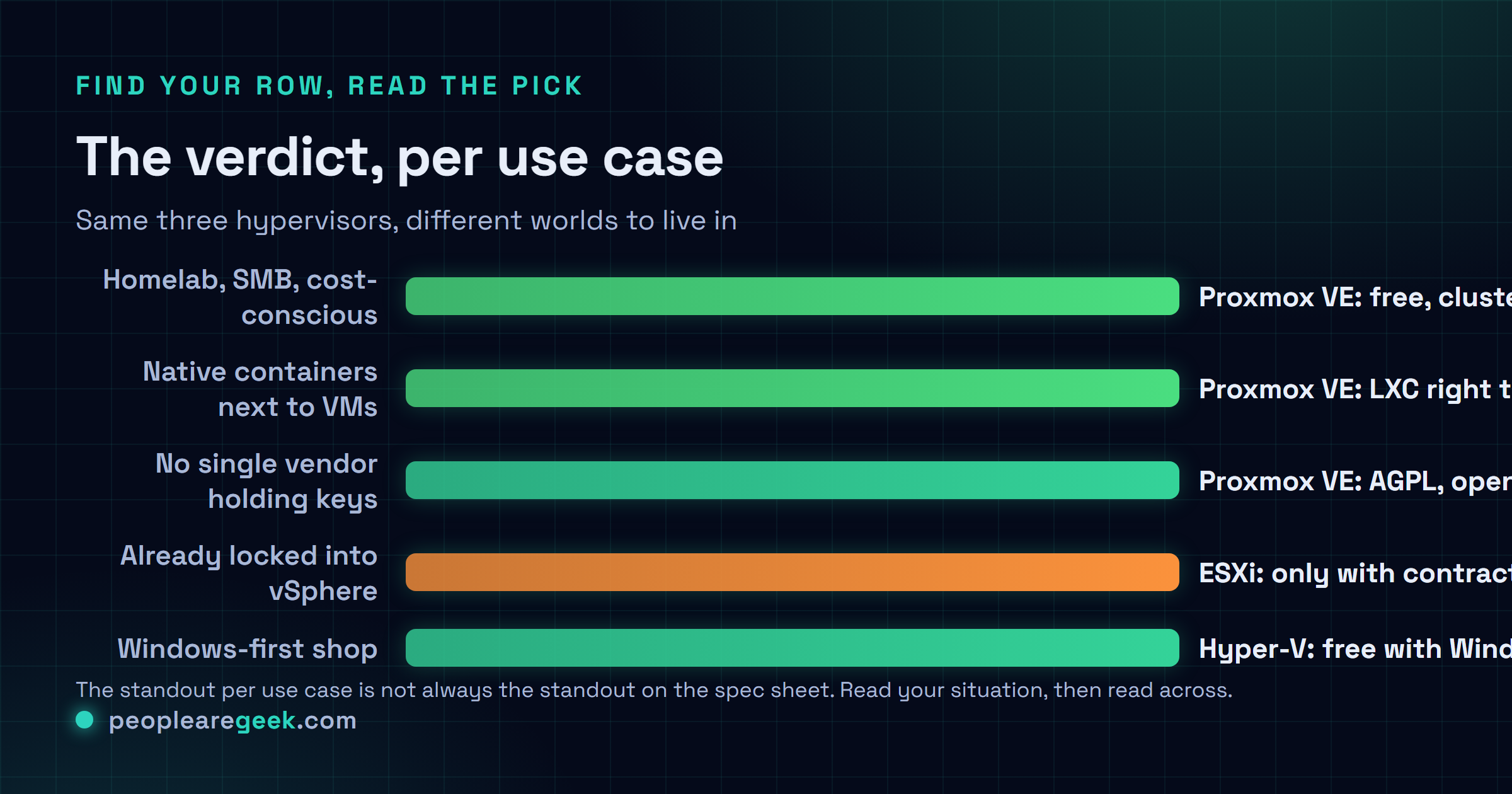
- Homelab, small business, or anyone cost-conscious? Proxmox VE. It's free, it clusters, it backs up, it does containers, and it absorbed the VMware exodus for a reason. This is my default recommendation for almost everyone in 2026, and I run it myself.
- Already enterprise-locked into vSphere with a trained team? ESXi, but only then. If you've got the contracts, the SAN, and the muscle memory, the switching cost can outweigh the licensing pain. Starting fresh, though? Don't walk into that bill.
- A Windows-first shop? Hyper-V. You already own it, it plugs into Windows Admin Center and AD, and managing everything from one console is worth a lot. Just know the free standalone server SKU is gone and Linux guests are second-class citizens.
- Want native containers next to your VMs? Proxmox, no contest. LXC is right there.
- Twitchy about one vendor holding the keys? Proxmox. It's AGPL, open source, no tier to second-guess, no acquisition that can rewrite your pricing overnight. After the last two years, I get why that matters to people.
Frequently asked questions
Is Proxmox really free, or is there a catch?
Genuinely free. The full hypervisor, clustering, ZFS, Ceph, all of it, no paywall. The only thing you can pay for is a support subscription that also gives you access to the more heavily tested enterprise package repository. You can run the no-subscription repo forever at zero cost, and tons of people do. For production I'd budget for the subscription anyway, it's cheap next to a VMware quote and it keeps your updates on the stable track. But there's no feature locked behind it.
Did Broadcom actually kill the free ESXi tier?
Effectively, yes. After the acquisition VMware moved to subscription-only licensing and discontinued the free standalone ESXi hypervisor that homelabbers had relied on for years. There's been back-and-forth and some limited reinstatement, but nobody I know trusts it as a long-term plan anymore. The practical reality in 2026 is that you should not build anything on the assumption of free ESXi. That uncertainty, more than the price itself, is what pushed people to Proxmox.
Can I migrate my ESXi VMs to Proxmox?
You can, and it's gotten a lot smoother. Recent Proxmox VE versions ship an import wizard that pulls VMs straight from an ESXi host, disks and config and all. It's not magic, you'll want to check the network setup and reinstall guest tools afterward, and very Windows-specific guests sometimes need a driver nudge. But for a typical small fleet it's an afternoon, not a nightmare. Take a backup first, obviously, then migrate a low-stakes VM to learn the flow before you move anything important.
Is Hyper-V Server still a thing?
The free standalone Hyper-V Server product was discontinued, so no, you can't grab a no-cost dedicated hypervisor from Microsoft anymore. What you do instead is enable the Hyper-V role on a licensed Windows Server or Windows Pro install. If you're already paying for Windows, that's effectively free virtualization. If you were hoping for a free bare-metal Microsoft hypervisor, that ship has sailed, and Proxmox is the closest thing to what you wanted.
Which has the best backup story?
Proxmox, for cost and integration. Proxmox Backup Server is free, deduplicated, incremental, and built specifically for the platform. With ESXi and Hyper-V the gold standard is Veeam, which is genuinely superb but a separate purchase and licensing commitment. So if backup budget matters, Proxmox plus PBS is hard to beat. If you're already a Veeam shop with a contract, that strength carries over to any of the three, and it's a fine reason to stay put.