Tailscale vs WireGuard is a slightly broken question, because Tailscale is WireGuard. Same crypto, same data plane, same kernel module doing the actual encryption. What Tailscale adds is the part WireGuard deliberately left out: a control plane that hands out keys, punches through NAT, runs MagicDNS, enforces ACLs and wires everything to your SSO. So the real choice is not WireGuard versus Tailscale, it is do you want to wire the mesh yourself or let a coordination service do it, and whether a hosted control plane seeing your metadata is fine or you self-host that part too with Headscale. Here is how it shakes out across setup, NAT traversal, keys, ACLs, performance, privacy and cost.
The short answer
Tailscale is WireGuard plus a control plane. Your packets still ride plain WireGuard tunnels, but Tailscale distributes keys, traverses NAT via DERP, runs MagicDNS and enforces ACLs wired to your SSO. So pick raw WireGuard for a small, static set of machines you own, Tailscale for roaming devices and teams, or Headscale when you want Tailscale's experience without handing coordination metadata to a SaaS.
I run both. WireGuard sits on a VPS for the boxes I want stitched together by hand, and Tailscale runs across a messier pile of laptops, phones and a couple of cloud VMs that move around too much for me to babysit configs. People keep asking which one to pick, and the question is a bit broken, honestly. Tailscale is WireGuard. Same crypto, same data plane, same kernel module doing the actual encryption. What Tailscale adds is the part WireGuard deliberately left out: a control plane that hands out keys, punches through NAT, runs MagicDNS, enforces ACLs, and wires everything to your SSO. So the real choice isn't WireGuard versus Tailscale. It's "do I want to wire the mesh myself, or let a coordination service do it", and right behind that, "am I fine with a hosted control plane seeing my coordination metadata, or do I want to self-host that part too with Headscale". Let me walk through how it actually shakes out.
They are not really competitors
Start here, because most "Tailscale vs WireGuard" arguments are people talking past each other. WireGuard is a tunnel protocol. It encrypts packets between two peers that already know each other's public keys and IP endpoints. That's the whole job. It doesn't tell peers how to find each other, doesn't distribute keys, doesn't deal with NAT. By design. The author kept it small on purpose, around 4 000 lines of kernel code, and pushed everything else out to user space.
Tailscale picked up everything WireGuard pushed out. Under the hood your traffic still rides plain WireGuard tunnels. On top of that sits a coordination server that knows which devices belong to your network, swaps their public keys around, helps them find each other through NAT, and applies your access rules. That's the split. WireGuard is the engine. Tailscale is the engine plus the gearbox, the dashboard, and the valet who parks it for you. Comparing them straight is like comparing a motor to a car. Useful question anyway, because you genuinely do choose between "I'll build the car" and "I'll buy one".
The honest comparison table
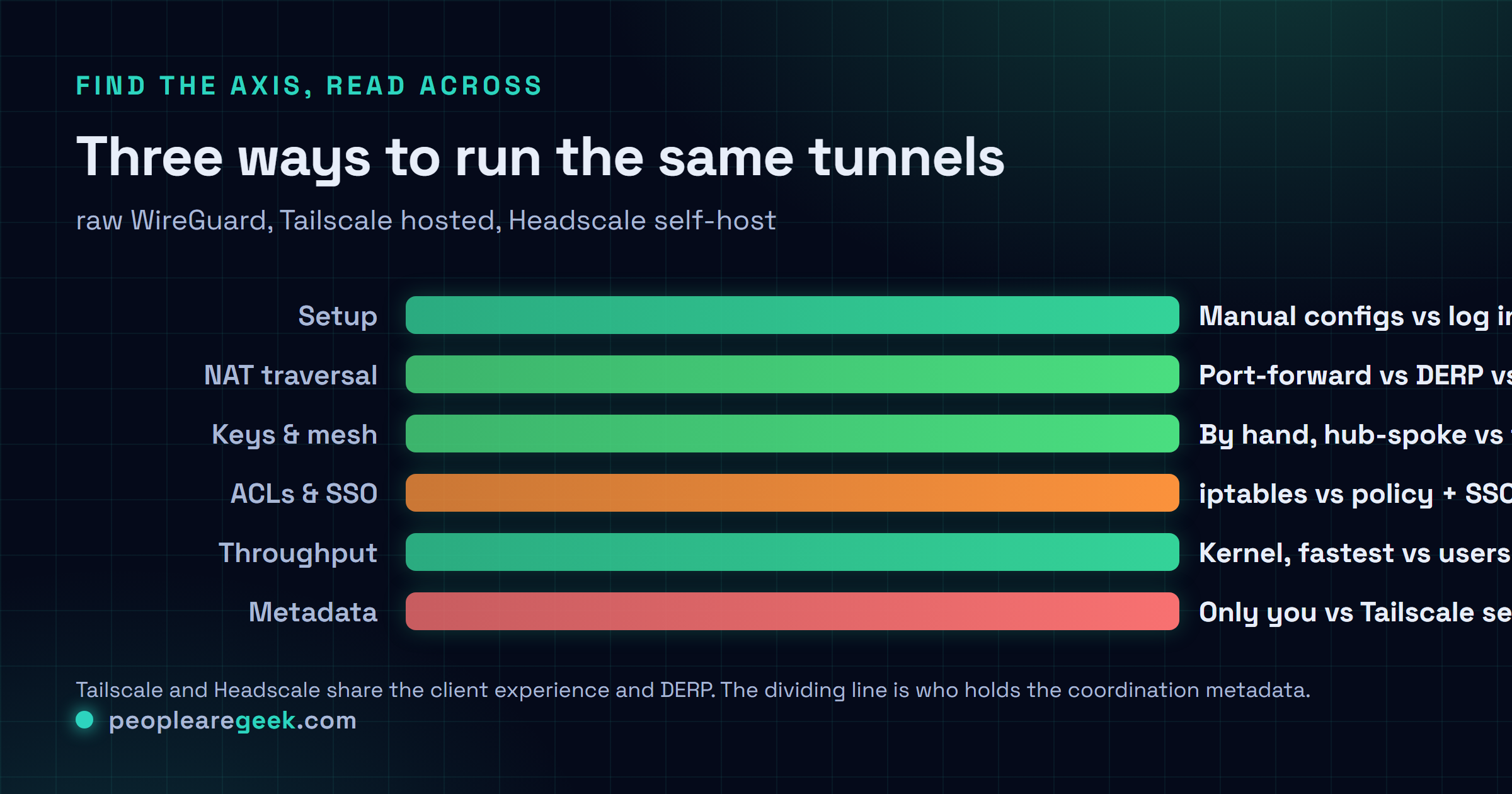
Here's how the two stack up on the things you'll actually feel. I'm putting Headscale in its own column because for a lot of readers it's the answer that quietly wins: Tailscale's experience, your control plane.
| What you care about | Raw WireGuard | Tailscale (hosted) | Headscale (self-host) |
|---|---|---|---|
| Setup effort | Manual configs per peer | Install, log in, done | Run the control server, then Tailscale clients |
| NAT traversal | You port-forward yourself | Automatic via DERP | Automatic via DERP |
| Key distribution | By hand, like SSH keys | Control plane does it | Your control plane does it |
| Topology | Hub and spoke (usually) | Full mesh, zero config | Full mesh, zero config |
| ACLs and SSO | Firewall rules by hand | Built in, Google or GitHub login | ACLs yes, SSO depends on setup |
| Raw throughput | Kernel WireGuard, fastest | Often userspace, slightly slower | Same as Tailscale clients |
| Who sees metadata | Nobody but you | Tailscale sees coordination data | Nobody but you |
| Cost | Just the VPS | Free tier capped, then per user | Free, your hosting only |
| Best fit | Static site to site you own | Roaming devices, teams, zero config | Self-host purist who wants the UX |

Setup effort
This is the gap that surprises people the first time. With raw WireGuard you generate a keypair per device, write an [Interface] block and a [Peer] block for every other machine it talks to, and get the AllowedIPs lines right on both ends. For three devices it's twenty minutes. For fifteen devices that roam, it's a part-time job, and every new laptop means editing configs on every peer it needs to reach. I've done it. It's fine until it isn't.
Tailscale is one binary and a login. You install the client, run tailscale up, authenticate against your Google or GitHub account in a browser tab, and the machine shows up on your tailnet with a stable 100.x address. No keys to copy. No ports to forward. The next device you add can reach it immediately, because the control plane already told both sides about each other. Headscale gives you that same client experience, the catch being you first stand up the Headscale server yourself and point your clients at it instead of Tailscale's coordination service.
NAT traversal, the killer feature
If I had to name the one thing that makes people switch, it's this. Plain WireGuard needs at least one peer reachable at a fixed, routable endpoint. That usually means a VPS with a public IP, or forwarding a UDP port on your home router and hoping your ISP isn't sticking you behind carrier-grade NAT. When both ends are behind NAT, raw WireGuard simply can't connect them on its own.
Tailscale makes that problem mostly vanish. Its coordination service helps both peers discover their public-facing address and port, then both sides fire packets outward at the same time so each one's NAT sees a reply it expects. That's the hole punch. When direct connection genuinely can't happen, traffic falls back to a DERP relay, Tailscale's network of WireGuard-aware relay servers that forward your already-encrypted packets. DERP only sees ciphertext, never your plaintext, and the moment a direct path opens up your connection silently upgrades to it. The result is two laptops on two hostile coffee-shop networks talking directly, with nothing port-forwarded anywhere. Raw WireGuard can't do that. Headscale can, because it speaks the same protocol and can use DERP relays too.
Key management and mesh shape
With WireGuard, keys are your job. You treat them like SSH keys: generate a pair per peer, never reuse one across two machines (that breaks the handshake in confusing ways), hand the public half over a channel you trust. For a handful of boxes that's clean and auditable. I actually like it for a static setup. There's nobody in the loop, and I know exactly what's where.
The shape matters too. Raw WireGuard configs almost always end up hub and spoke, because a true full mesh means every peer holding every other peer's key and a config block to match. The math gets ugly fast, roughly n-squared blocks to maintain. Tailscale and Headscale give you a full mesh for free: every node can reach every other node directly, and the control plane keeps all the keys in sync as devices come and go. You add a phone, it can talk to everything, and you edited nothing.
ACLs, SSO and exit nodes
Plain WireGuard has no concept of identity beyond a public key, and no access rules beyond what you build with AllowedIPs and the host firewall. Want "contractors can reach the staging box but not prod"? You're writing iptables. It works, it's just manual, and it drifts.
Tailscale ships a real access-control policy you edit as one file, expressed in terms of users and tags, wired to your SSO so identity comes from Google Workspace or GitHub or whatever you already run. Exit nodes are a nice extra: flag one device as an exit node and other devices can route all their internet traffic through it, which is the classic full-tunnel VPN trick, except you didn't configure a thing on the client beyond picking it from a menu. Headscale supports ACLs in the same policy format and supports exit nodes too. SSO on Headscale is more of a "depends how you wired it" answer, since you're providing the identity backend yourself.
Performance
Raw kernel WireGuard is the throughput champion, and it's not really close on paper. The data path lives in the kernel, ChaCha20-Poly1305 runs cheap, and a single core will saturate a gigabit link without breaking a sweat. Tailscale uses WireGuard too, but historically its client ran the crypto in user space (wireguard-go), which costs you some throughput and a bit more CPU compared to the in-kernel path. On a fast link you can measure the difference.
Do you feel it? For most people, genuinely no. If your bottleneck is a 200 Mbps home uplink, both pin it. The gap shows up when you're moving big traffic over a 1 Gbps-plus path and counting every percent. And Tailscale has been narrowing it, leaning on kernel WireGuard where the platform allows. So: raw WireGuard wins the benchmark, Tailscale wins "I didn't have to think about it", and on a normal connection you won't notice which one you're on.
Privacy, trust and Headscale
This is the part worth slowing down on. Your traffic is end to end encrypted in every case. Tailscale's servers do not see your plaintext, full stop, and DERP relays only ever touch ciphertext. But the hosted control plane does see coordination metadata: which devices are in your tailnet, their public keys, their endpoints, roughly when they connect. For most people that's an acceptable trade for never thinking about NAT again. For some, having a third party hold that map is exactly the thing they're trying to avoid.
That's where Headscale comes in. It's an open-source, self-hosted implementation of the Tailscale control server. You run it on your own box, point the normal Tailscale clients at it, and you get the mesh, the NAT traversal, the MagicDNS-style naming, the ACLs, with no Tailscale SaaS in the loop and no coordination metadata leaving your control. The cost is that you're now operating the control plane: another service to keep up, patch, and back up. For the self-host purist who wants Tailscale's experience without the dependency, it's the answer. If you already self-host things like a password manager, you're in this mindset anyway, see our Vaultwarden self-host guide for the same trade in a different shape.
One honest caveat on Headscale. It tracks the Tailscale protocol but it's a separate project, so it can lag behind new client features, and a few Tailscale niceties aren't there or work differently. Read its docs before you commit a fleet to it.
When each one wins
Here's where I land after running both for a while.
- Raw WireGuard when you've got a small, static set of machines you control, ideally with at least one on a public IP, and you want zero third parties and maximum throughput. Site to site between two offices you own? A VPS plus three home boxes? This is the clean answer. Our self-hosted WireGuard guide walks the whole build.
- Tailscale when you've got many devices that roam, a team that needs SSO and ACLs, or anything behind CGNAT where port forwarding isn't even on the table. The zero-config mesh and automatic NAT traversal are worth real money in saved time. If the free tier covers you (and for a solo user or tiny team it usually does), it's hard to argue with.
- Headscale when you want everything Tailscale gives you but refuse to hand coordination metadata to a SaaS. You trade a bit of operational work for full ownership. The purist's pick, and a good one if you've already got the self-hosting habit.
I might be wrong for your exact setup, but the dividing line that's held up for me is roaming. If devices move and hide behind NAT, you want a control plane, hosted or self-hosted. If they sit still on IPs you own, raw WireGuard is less to break.
Sources and further reading
- Tailscale, how it works (architecture and control plane)
- Tailscale, DERP relays and NAT traversal
- WireGuard, official site
- Headscale, open-source Tailscale control server
Frequently asked questions
Is Tailscale just WireGuard with extra steps?
It's WireGuard with the missing steps filled in, which is the opposite of extra. Tailscale runs plain WireGuard for the actual data tunnels, then adds the parts WireGuard left out on purpose: key distribution, NAT traversal through DERP, MagicDNS, ACLs, and SSO login. So you're not paying a performance tax for a different protocol. You're paying a small throughput cost (userspace crypto on some platforms) in exchange for never wiring the mesh by hand.
Does Tailscale see my traffic?
No, not the contents. Your traffic is end to end encrypted with WireGuard, and Tailscale's servers never hold the keys to decrypt it. Even the DERP relays only ever forward ciphertext. What the hosted control plane does see is coordination metadata: which devices are on your network, their public keys, their endpoints, when they connect. If that map bothers you, self-host the control plane with Headscale and it never leaves your hands.
What is Headscale and why would I use it?
Headscale is an open-source, self-hosted version of Tailscale's coordination server. You run it yourself, point the standard Tailscale clients at it, and you get the same mesh, NAT traversal, and ACLs without Tailscale's SaaS in the loop. People use it to keep coordination metadata fully private, or just to avoid depending on a hosted service. The trade is that you now operate that control plane, one more thing to patch and back up, and it can lag behind new Tailscale features.
Which is faster, Tailscale or raw WireGuard?
Raw WireGuard, on paper. Its data path runs in the kernel, and a single core will fill a gigabit link. Tailscale often runs the crypto in user space, which costs some throughput and CPU on a fast link. In practice, on a normal home or office connection, both saturate your uplink and you won't feel the difference. The gap only shows up when you're pushing 1 Gbps-plus and counting every percent.
Can I avoid port forwarding with plain WireGuard?
Only partly. A WireGuard client behind NAT can reach a server that has a public, routable endpoint, because the client opens the session outbound. The problem is when both ends are behind NAT, especially carrier-grade NAT, where neither can be dialled directly. Raw WireGuard has no hole-punching of its own, so you're stuck. That exact case is where Tailscale or Headscale earn their keep, since their control plane traverses NAT and falls back to a relay when it has to.