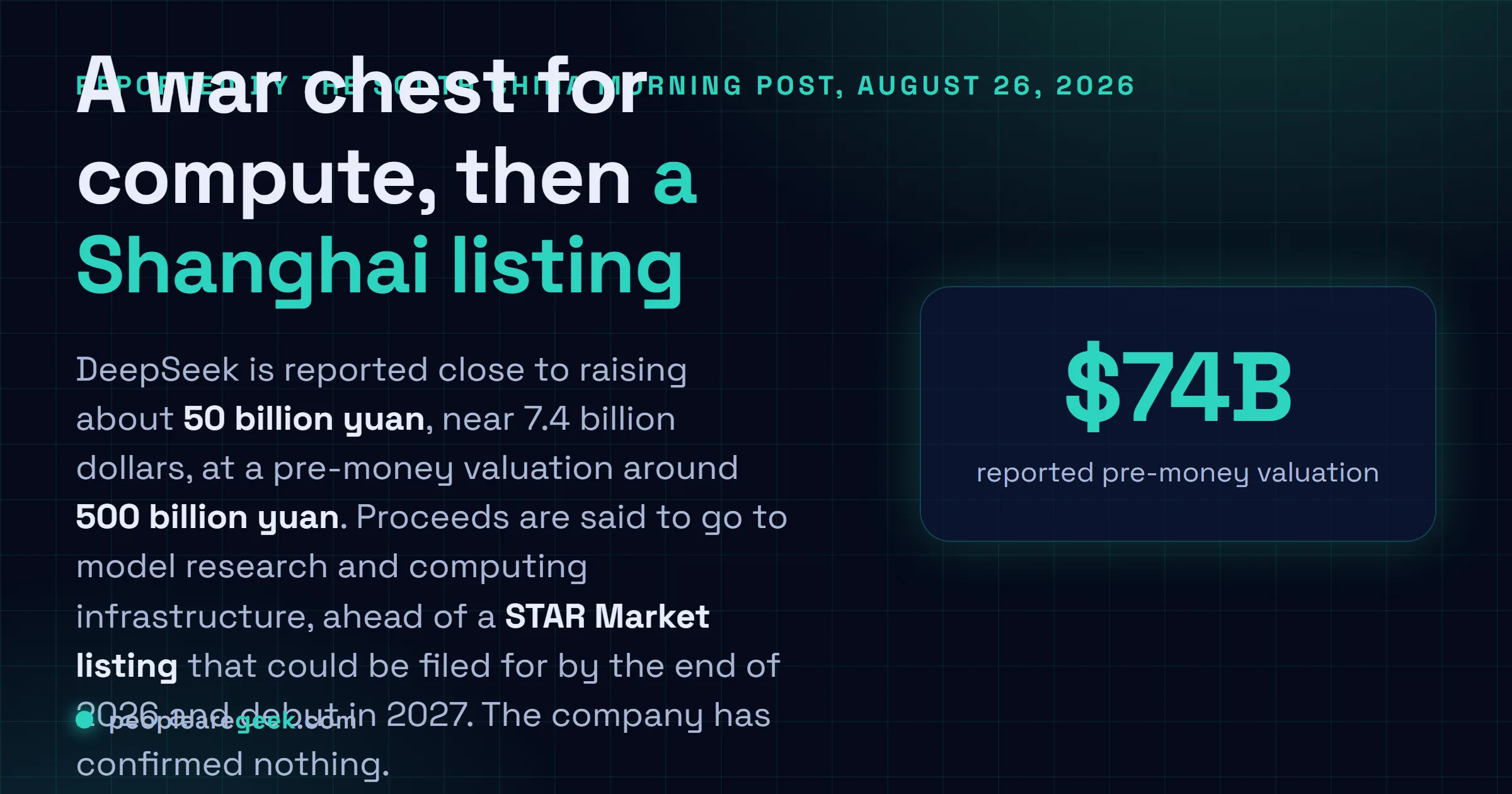
DeepSeek is close to completing a funding round of roughly fifty billion yuan, about 7.4 billion dollars, at a pre-money valuation near five hundred billion yuan or 74 billion dollars. The reporting comes from the South China Morning Post and has been picked up widely since, with the round expected to close around the end of August 2026 and a listing on Shanghai's STAR Market pencilled in for 2027. None of it has been announced by the company. For anyone running DeepSeek weights on their own hardware, the number that matters is not the valuation but what the money is for.
The short answer
Reporting from the South China Morning Post, repeated widely since August 26, 2026, has DeepSeek close to raising around fifty billion yuan at a pre-money valuation near five hundred billion yuan. Proceeds are said to be earmarked for model research and computing infrastructure, plus a cash reserve ahead of a listing on Shanghai's STAR Market that could be filed for as early as the end of 2026 and debut in 2027. Existing investors named include Monolith, Shixiang Capital and CATL. The company has confirmed none of it.
Most funding news is other people's money moving around. This one is worth reading because DeepSeek is a lab whose output a lot of engineers have running on their own hardware, and the money is reportedly going into the thing that decides whether that continues.
What is reported, and by whom
The figures originate with the South China Morning Post and have been carried by financial and technology outlets through the week. The round is around fifty billion yuan, roughly 7.4 billion dollars, at a pre-money valuation of about five hundred billion yuan, roughly 74 billion dollars, with completion expected around the end of August 2026.
The investor list mixes categories that rarely appear together in Western rounds. Existing backers include the venture funds Monolith and Shixiang Capital, alongside battery manufacturer CATL. Names mentioned as prospective participants include CPE, Legend Capital, Stony Creek Capital, funds backed by GigaDevice, and state investment vehicles from Hefei. Private venture capital, industrial corporates and local government money in the same cap table is the standard shape for a large Chinese technology round heading toward a domestic listing.
That listing is the point of the exercise. Reporting points to a possible filing as early as the end of 2026 and a debut in 2027 on the STAR Market, the Shanghai exchange's technology board, which accommodates companies that spend heavily on research without a long profit record.
The gap the chart shows

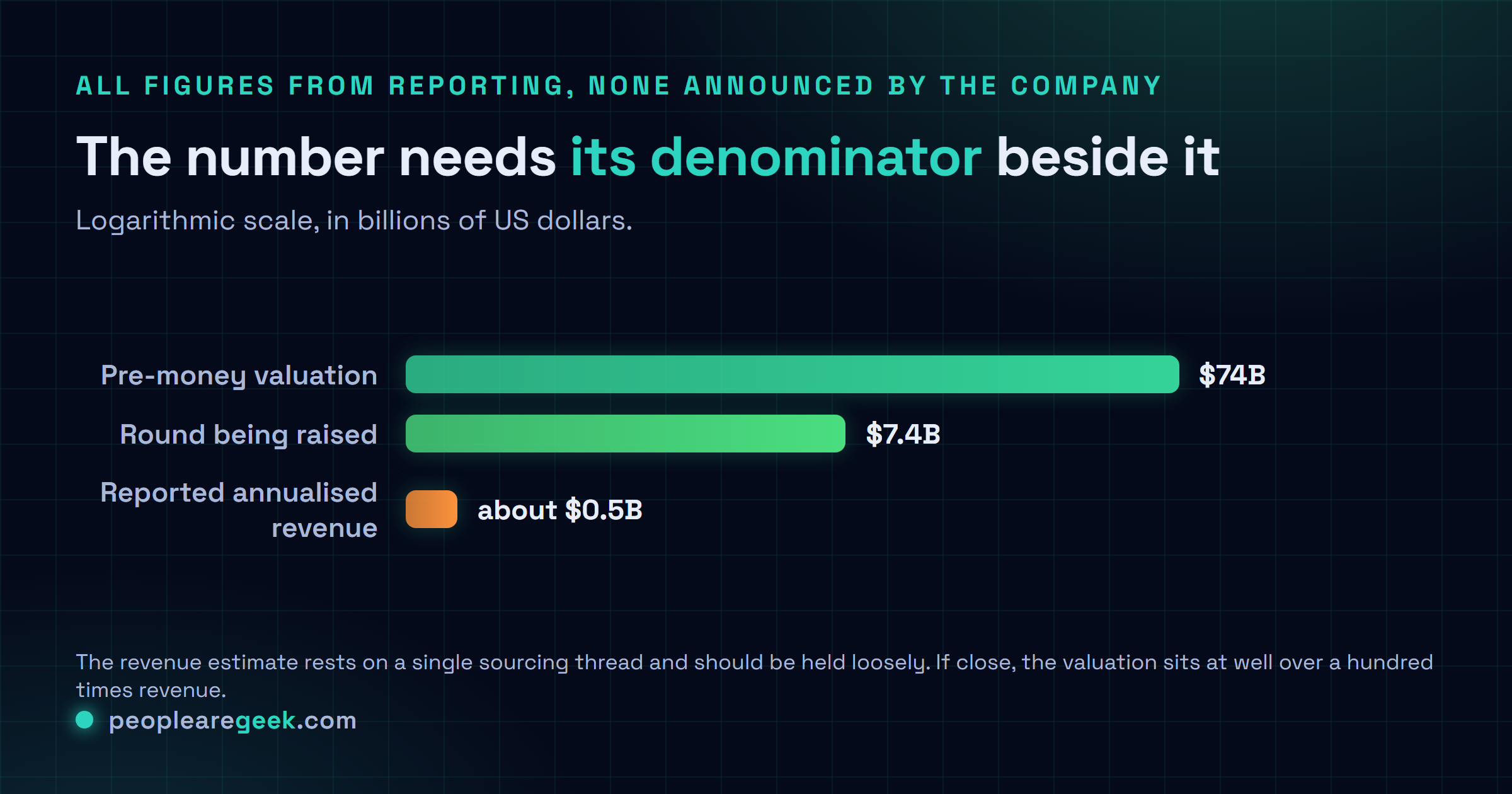
Reporting around the round puts annualised recurring revenue near five hundred million dollars. That figure is thinner sourced than the others and should be held loosely, but if it is close, the valuation sits at well over a hundred times revenue.
That multiple is not an anomaly in this sector, it is the sector. It prices an expectation about model capability and distribution several years out rather than the current income statement, which is the same logic behind Hugging Face fielding interest at thirteen billion dollars and behind a16z raising a fund aimed at the infrastructure underneath the models. It is worth stating plainly rather than leaving implied, because a number like 74 billion means very little without the denominator next to it.
Why an engineer should care
The reported use of proceeds is model research and computing infrastructure. In a year where accelerator supply and data centre power have been the binding constraint on every lab, a raise of this size is mostly a claim on capacity, and capacity is what determines both how often new models appear and what they cost to use.
DeepSeek built its position by publishing weights people could actually run and by pricing its API aggressively, including the peak and off peak tiers introduced with V4 Pro. Both of those are choices, not commitments. A funded company with a listing ahead of it has the resources to keep making them and, for now, a strong commercial reason to, since open releases are how the distribution was built in the first place.
The caveat is the one that applies to every model you did not train. A listing brings shareholders, and shareholders may hold different views about giving away weights. If something you ship depends on a specific DeepSeek model, keep a copy of the weights and licence you are relying on, pin the version, and know what you would move to. That advice has not changed, and no funding round changes it. What changes is only how much compute sits behind the next release.
Sources and further reading
- DeepSeek nears pre-IPO funding round as 2027 market debut takes shape, South China Morning Post, August 26, 2026
- DeepSeek Nears $7.4 Billion Funding Round at $74 Billion Valuation Ahead of 2027 IPO, China Money Network, August 29, 2026
- DeepSeek nears $7.4 billion funding round at $74 billion valuation ahead of 2027 IPO, Tech Startups, August 28, 2026
Frequently asked questions
Has DeepSeek confirmed any of this?
No. Everything here comes from reporting attributed to people familiar with the process, initially in the South China Morning Post and then repeated across financial and technology outlets. The company has not published a statement, no filing is public, and the figures could move before anything closes. Treat the amounts as well sourced reporting rather than as confirmed fact, which is the normal state of pre-listing rounds in any market.
What is the STAR Market?
It is the Science and Technology Innovation Board of the Shanghai Stock Exchange, launched in 2019 and aimed at technology companies, with lighter profitability requirements than the main board and a registration based listing process. It is where a Chinese company with heavy research spending and a short revenue history would list domestically. Reporting suggests a filing could come as early as the end of 2026 with a debut during 2027, which is a normal gap between the two events rather than a delay.
What would the money be spent on?
Model research and development and computing infrastructure, according to the reporting, plus building a cash reserve ahead of a listing and establishing a clearer equity pricing benchmark. The compute line is the one with technical consequences. Training and serving frontier scale models is the dominant cost for a company at this stage, and a raise of this size buys accelerator capacity and the data centre commitments that go with it, in a market where those commitments are the binding constraint.
Does this change anything for people self hosting DeepSeek models?
Not directly and not immediately. What it changes is the probability distribution over the next couple of years. A funded lab with a listing ahead of it has both the resources to keep training and a reason to keep publishing, since open weight releases are a large part of how DeepSeek built the distribution it now has. Nothing obliges the company to keep licensing terms as they are, and a listing introduces shareholders who may look at that differently, so the sensible posture for anyone with a hard dependency is the usual one: keep the weights you rely on, and know what you would switch to.
Who is reported to be investing?
Existing backers named in the reporting include the venture funds Monolith and Shixiang Capital along with battery manufacturer CATL. Prospective new participants mentioned include CPE, Legend Capital, Stony Creek Capital, funds backed by GigaDevice, and state investment vehicles from Hefei. That mix, private venture money alongside industrial corporates and local government capital, is characteristic of how large Chinese technology rounds are assembled ahead of a domestic listing.