The FreeBSD Foundation published a status report this week on a summer internship spent porting AMD's ROCm compute stack from Linux to FreeBSD, and Phoronix picked it up on August 30, 2026. The headline milestone sounds modest: the driver links, loads and runs, and a simple vector addition is within reach. Anyone who has moved a kernel level stack between operating systems will read that correctly. Getting a GPU compute runtime to the point where it can add two arrays means the LLVM fork, the runtimes, the kernel module and the compatibility layer underneath all agree on something.
The short answer
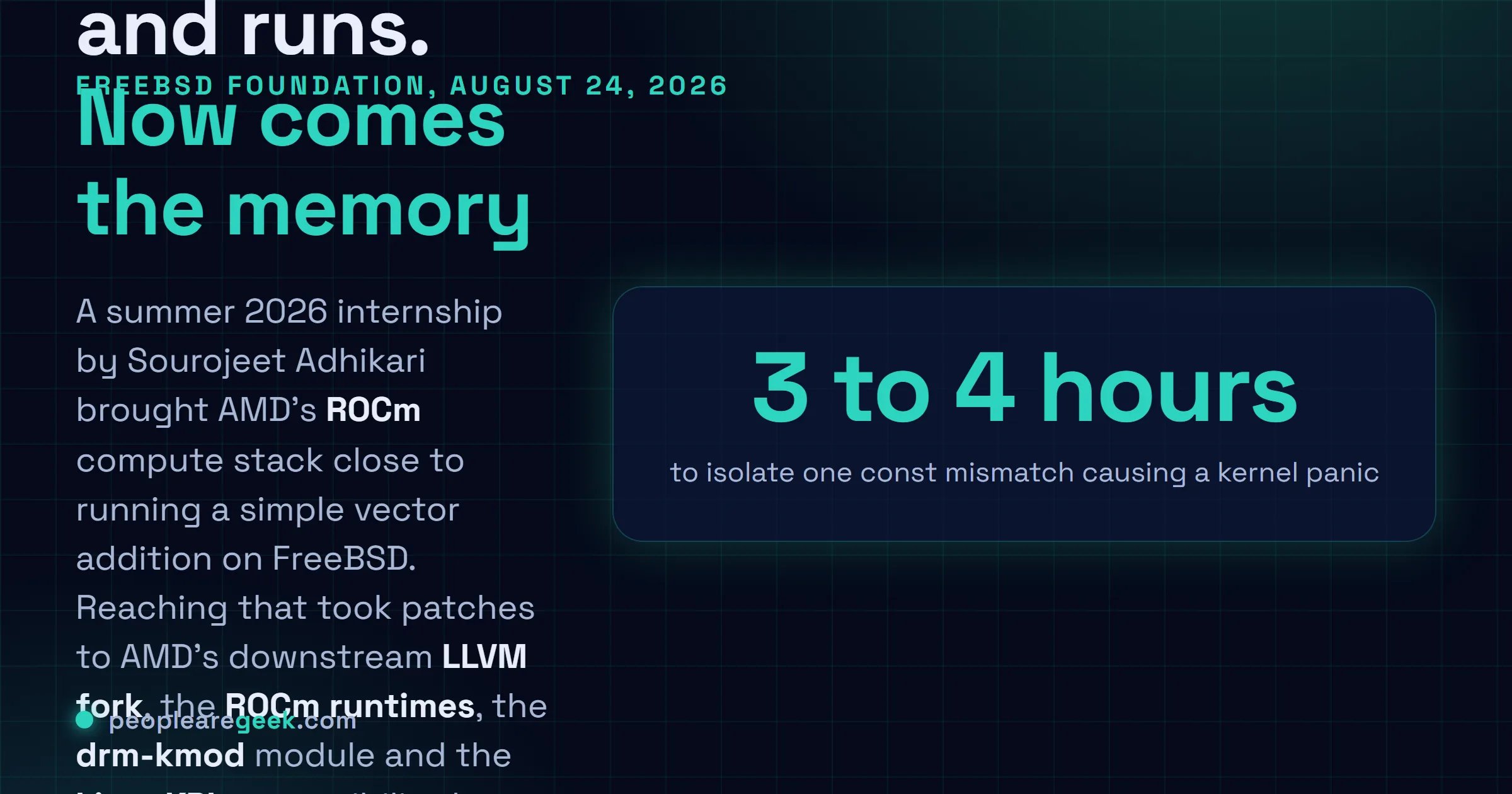
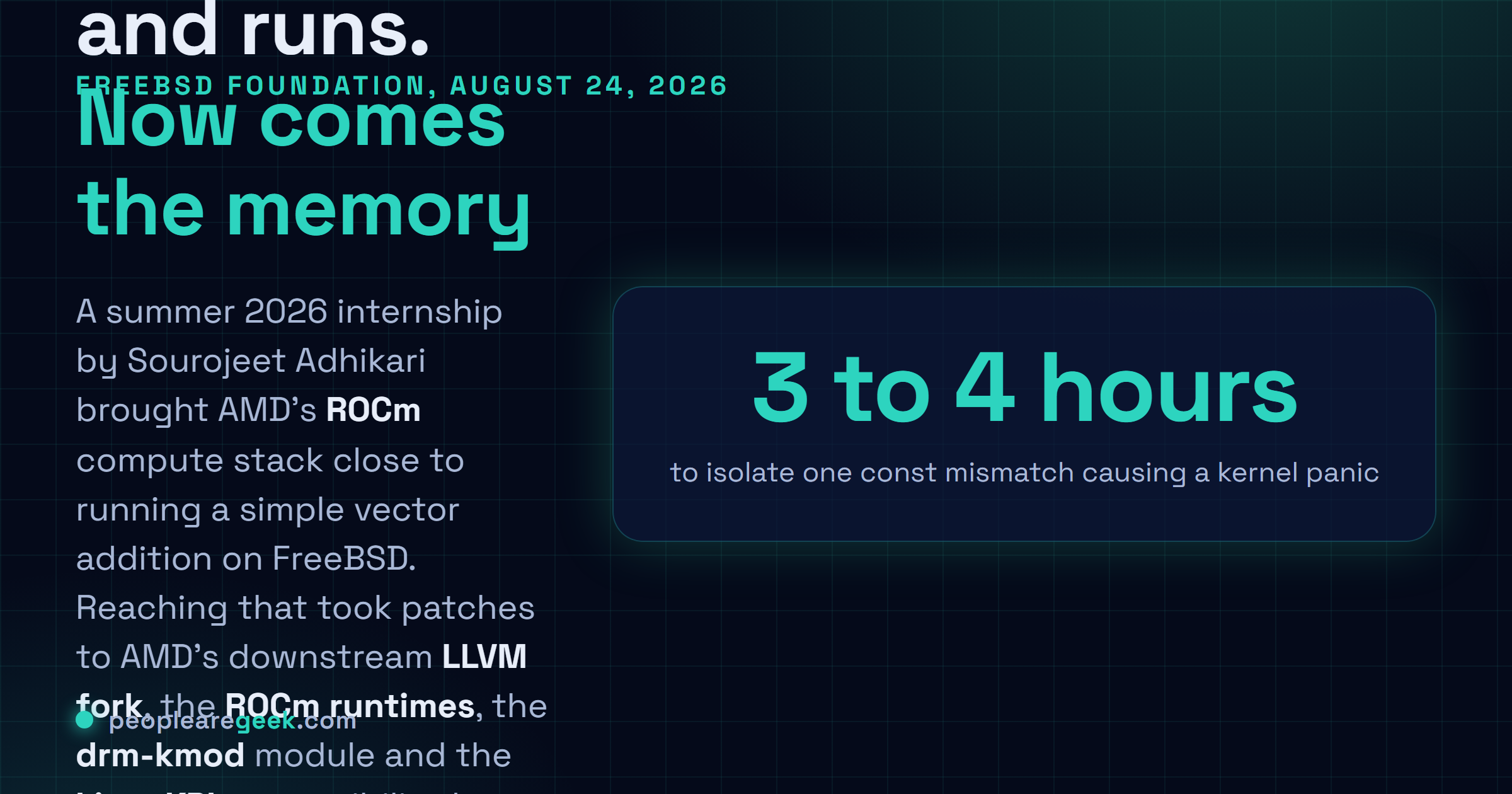
The FreeBSD Foundation published a report this week on a summer 2026 internship by student developer Sourojeet Adhikari, porting AMD's ROCm compute stack to FreeBSD, and Phoronix covered it on August 30, 2026. The driver now links, loads and runs, and the project is approaching a simple vector addition workload, with user space issues still open. Getting there required patches to AMD's downstream LLVM fork, the ROCm GPU runtimes, the drm-kmod module and the LinuxKPI compatibility layer, where a mutable versus constant mismatch in class_register caused a kernel panic and took several hours to isolate. Heterogeneous memory management in FreeBSD's virtual memory subsystem is named as the next area. This is not usable by end users yet.
Vector addition is the hello world of GPU compute. Reaching it from another operating system is not a beginner's result.
Why the port is hard even with a compatibility layer
FreeBSD has an AMDGPU driver, ported over from the Linux kernel DRM, and it has LinuxKPI, a layer that presents Linux kernel interfaces to code written against them. On paper that sounds like most of the problem solved. It is not, and the report is useful precisely because it says why.
A compatibility layer has to match the exact expectations of the interface, not just its name and arguments. The example given in the report is a debugging session of three to four hours that ended at a mutable versus constant data structure mismatch in LinuxKPI's class_register. AMD kernel code written against newer Linux behaviour called in, the qualifier did not line up, and the machine panicked. Nothing in the function signature tells you that is going to happen. You find it by bisecting a panic.
That is the texture of this kind of work. The visible progress is a driver that loads. The invisible progress is a list of places where two kernels quietly disagreed and somebody had to find out which one to change.
Four layers, all of which had to move

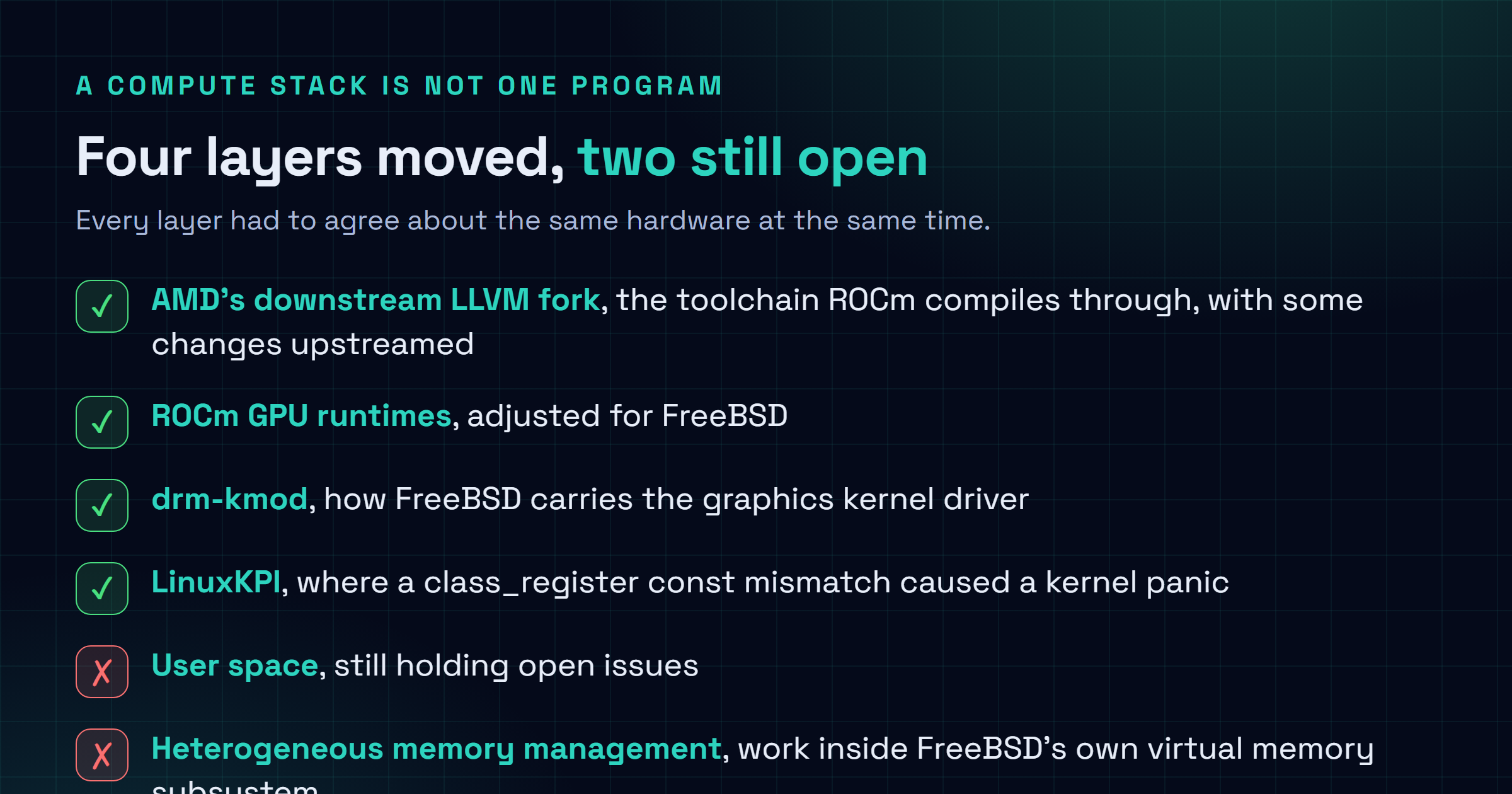
The work was not confined to the kernel. AMD maintains a downstream LLVM fork that ROCm compiles through, and that needed patching, with some of the changes going upstream. The ROCm GPU runtimes needed adjusting. The drm-kmod module, which is how FreeBSD carries the graphics kernel driver, needed changes. And LinuxKPI needed fixes for the bugs and behavioural differences the port exposed.
That spread is the reason porting a compute stack takes longer than porting an application. A compiler toolchain, a user space runtime, a kernel module and a compatibility shim all have to agree about the same hardware at the same time, and a mismatch anywhere shows up as a failure somewhere else.
What is left, and why it is the expensive part
Heterogeneous memory management is named as the next area of exploration, and that is the honest place to put a marker.
HMM is the kernel machinery that lets a GPU and a CPU share one address space: a pointer means the same thing on both sides, and pages migrate on demand rather than being explicitly copied. Modern GPU compute assumes it exists. Getting it on FreeBSD is not a matter of translating a Linux interface, because FreeBSD's virtual memory subsystem is genuinely different. It is work inside that subsystem.
The internship has ended, and Sourojeet plans to continue. That is worth saying plainly rather than dressing up: the current state is one developer, past the hardest early debugging, in front of the biggest remaining piece.
The wider point about vendor compute stacks
ROCm is open source, which is what makes this attempt possible at all. It is also large, fast moving and written against Linux, which is what makes it hard. AMD spent this year reorganising it, jumping straight to ROCm 10.0 with a developer stack, and every reorganisation upstream is more surface for a port to chase.
Compare it with the road a graphics API takes. When a vendor feature ships as a Vulkan extension, as NVIDIA optical flow did in FFmpeg this weekend, everything that speaks Vulkan inherits it, including FreeBSD. A vendor compute stack takes the other road, and somebody has to carry it there by hand.
Do not plan a FreeBSD compute deployment on this. Do read the report if you are interested in what porting actually costs, because it is a rare public account with the debugging left in.
Sources and further reading
- FreeBSD Foundation intern Sourojeet Adhikari on bringing ROCm to FreeBSD, FreeBSD Foundation blog, August 24, 2026
- ROCm on FreeBSD, FreeBSD quarterly status report, April to June 2026
- The Challenges In Bringing AMD ROCm To FreeBSD, Phoronix, August 30, 2026
Frequently asked questions
What state is ROCm on FreeBSD actually in?
Not usable for end users, and honest about it. The FreeBSD Foundation report says the project is approaching the milestone of running a simple vector addition workload, and that the driver can link, load and run while issues remain in user space. The work was done by student developer Sourojeet Adhikari during a Foundation internship over the summer of 2026. The internship has ended and the developer plans to keep going, with heterogeneous memory management named as the next area.
What had to be patched to get this far?
Four layers. AMD's downstream LLVM fork used by ROCm, with some changes upstreamed. The ROCm GPU runtimes. The drm-kmod module, which is how FreeBSD carries the graphics kernel driver. And LinuxKPI, the FreeBSD compatibility layer that translates Linux kernel interfaces, where the port uncovered real bugs and behaviour differences rather than just missing functions.
Why is a compatibility layer not enough on its own?
Because it has to match not just the shape of a Linux kernel interface but its exact expectations. The report describes a debugging session of three to four hours that ended at a mutable versus constant data structure mismatch in LinuxKPI's class_register, which caused a kernel panic when AMD kernel code written against newer Linux behaviour called into it. A const qualifier is not a semantic difference you can guess at from an API signature, and that class of mismatch is what makes porting slow.
What is HMM and why does it matter here?
Heterogeneous memory management is the kernel machinery that lets a GPU and a CPU share a single address space, so a pointer means the same thing on both sides and pages migrate between them on demand. Modern GPU compute assumes it. FreeBSD's memory management systems work differently from Linux's, so this is not a translation job, it is work in the FreeBSD virtual memory subsystem itself. It is named as the next area of exploration, which is a fair signal of how much is left.
Why would anyone want ROCm on FreeBSD?
The same reason anyone wants anything on FreeBSD: a licence and a base system that suit certain deployments, and appliances or storage platforms that already live there and would rather not gain a Linux host to run inference or compute jobs. FreeBSD already carries an AMDGPU driver ported from the Linux kernel DRM, so graphics support exists. Compute has been the gap. Nobody should plan around this yet, but the direction is worth tracking.