WIRED reported on August 28, 2026 that Meta is testing robots inside live data centers on work that has always belonged to technicians: swapping network cables, power cycling servers, reseating components and moving racks. The machines come from three vendors, they are deployed at named campuses in Iowa and Ohio, and by every account in the reporting they are slower than a person and beaten by dense cabling. That combination is the interesting part. It tells you which physical tasks in a hall are structured enough to automate today, and which ones are hard for reasons that will not go away quickly.
The short answer
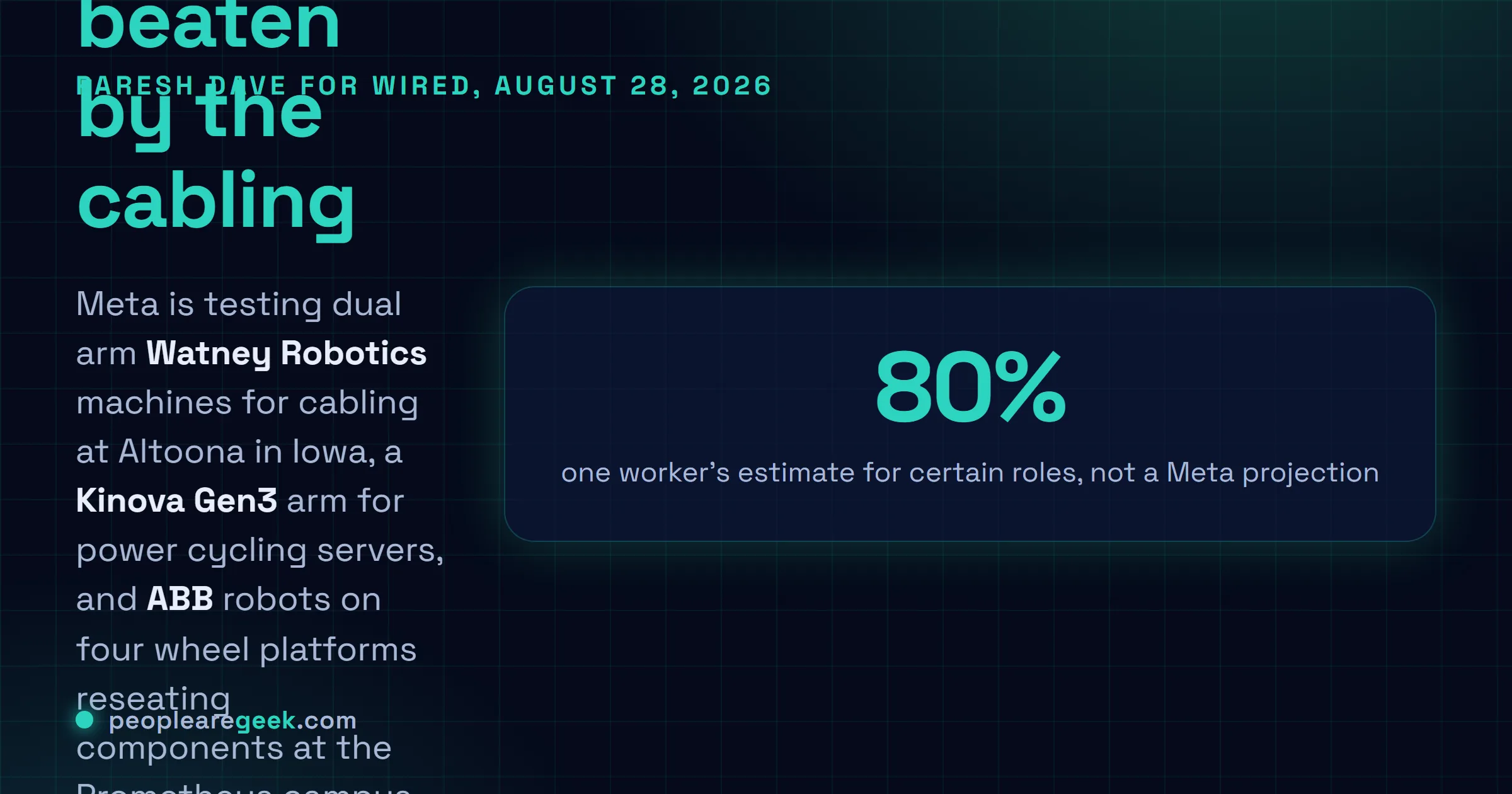
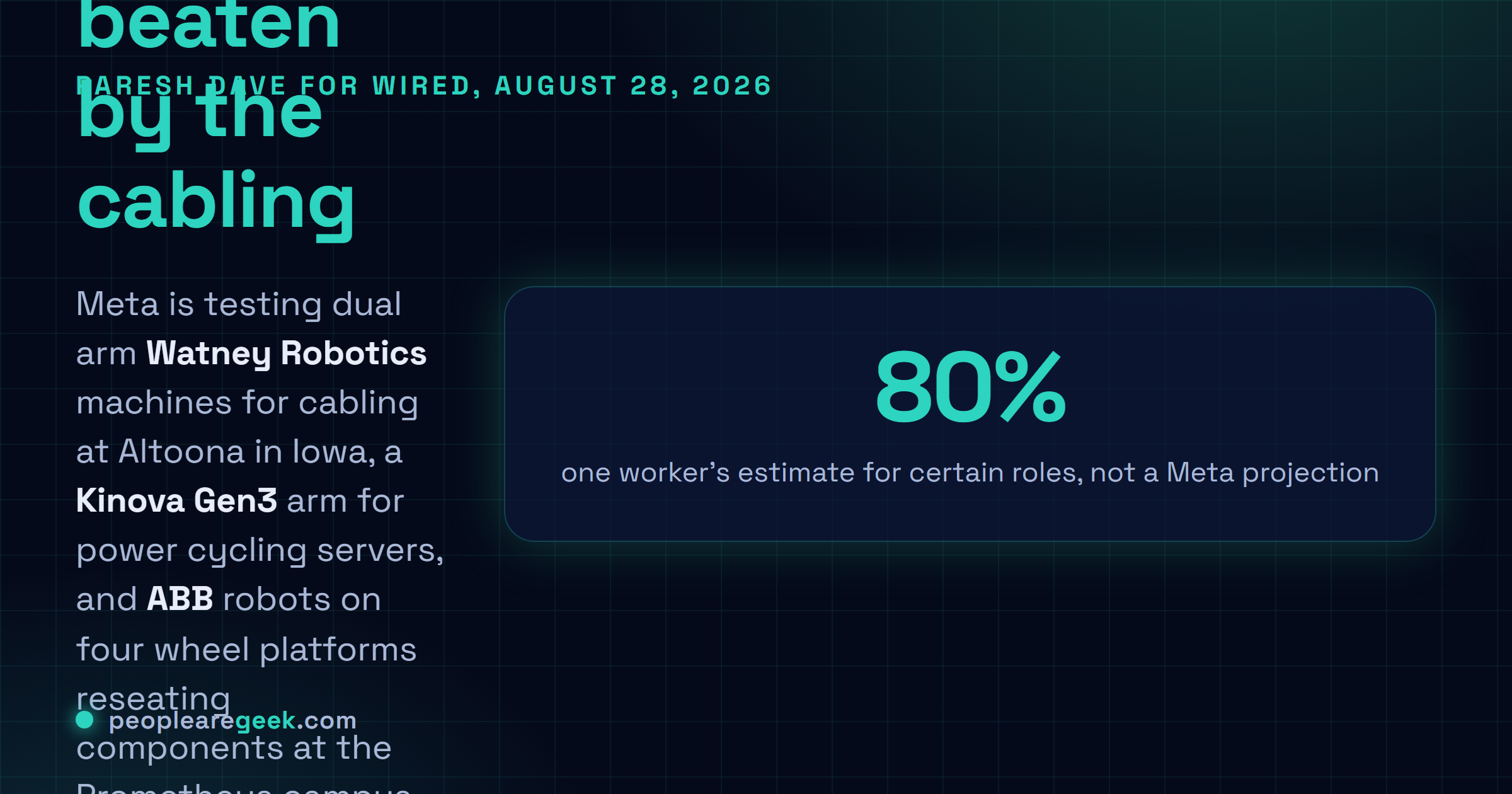
WIRED reported on August 28, 2026 that Meta is testing robots on data center floor work. Dual arm Watney Robotics machines are being tested for cabling at Altoona in Iowa. A Kinova Gen3 arm is being evaluated for power cycling servers. ABB robots on four wheel platforms reseat components at the Prometheus campus in New Albany, Ohio. The tasks in scope are cable swaps, power cycling, reseating, inspection and rack moves. The machines are slower than people, need supervision and charging, and struggle with dense cabling. One unnamed worker estimated a working cable robot could cover as much as 80 percent of the work in certain roles, which is an employee estimate rather than a Meta projection.
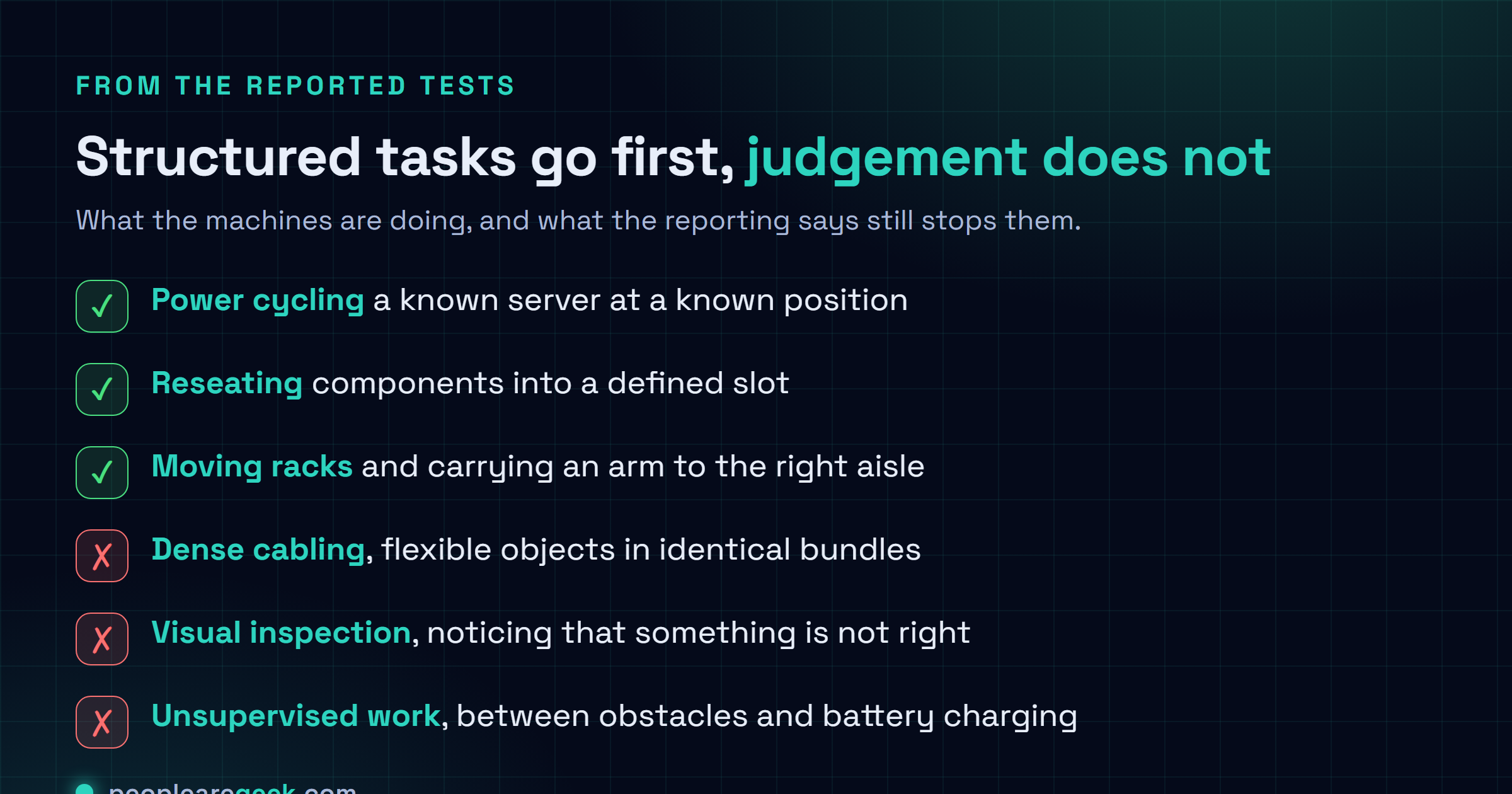
Anyone who has done a night in a data hall can read this task list and know exactly which items are easy and which are not.
The task list is the story
Power cycling a server is close to trivial to automate, and Meta already automates a crude version of it: some sites use a small remotely controlled device, described as looking like a mechanical finger, that presses the power button. The target is a known object at a known position, the action is one press, and success is easy to verify from the other side. A Kinova Gen3 arm doing the same job with more reach and more precision is an increment, not a leap.
Reseating a component sits a step up. There is a defined slot, a defined force, and a defined direction, but the part has to align and the rack has to be reachable. ABB machines on four wheel platforms handle that at the Prometheus campus, which tells you the mobility problem, getting the arm to the right rack, is being solved separately from the manipulation problem.
Cabling is the hard one, and it is the one Meta put dual arm robots on. A patch cable is a flexible object whose shape is unknown until you look at it, tangled with dozens of near identical neighbours, with a connector that must seat squarely and a latch that must click. Every one of those properties is a known difficulty in robotic manipulation. The reporting says the machines struggle with complicated cabling, which is the outcome you would predict.
What the limitations imply for operations

Three constraints appear in every account, and each one has a practical consequence.
The machines are slower than people. That means the case for them is not throughput on a normal day, it is coverage at hours when nobody is on site, or on tasks nobody wants to walk for. A robot that takes four times as long but is already in the hall at three in the morning is still useful.
They need supervision. An automated task is therefore not an unattended task. Somebody watches, and the ratio of watchers to machines is the number that decides whether any of this pays.
They need charging. That is a scheduling problem more than a technical one, and it is the reason mobility and manipulation are being tested separately.
Visual inspection is listed among the things they struggle with, which is worth sitting with. Inspection sounds like the easiest task on the list and is often the hardest, because a technician is not matching a template, they are noticing that something is not right. That is the skill that does not decompose into instructions.
The staffing question, stated carefully
The number circulating from this reporting is 80 percent. It deserves its context. It came from one unnamed worker, describing what a properly working cable replacement robot could cover of the work performed in certain roles. It is not a Meta projection, it is not about data center headcount as a whole, and it sits in an article that also says the machines cannot match a person's speed today.
The concern the workers actually voice is more specific than headcount, and more interesting. They describe a shift away from hiring experienced troubleshooting technicians toward entry level staff who carry out instructions produced in real time, sometimes generated by software. That is a change in the shape of the role rather than a subtraction, and it is the sort of change that shows up first in what an incident looks like at four in the morning when the instructions do not fit.
Meta's own position is that it is still hiring and training, and that the country is in its biggest infrastructure boom since World War II with a serious shortage of skilled workers, so it needs more people rather than fewer. Both things can be true at once: capacity is growing faster than hiring can fill, and the tasks being automated are the ones that used to train juniors into seniors.
Why this is arriving now
The scale is the forcing function. Data center capacity commitments have been enormous this year, from Anthropic renting 460 MW in West Virginia to AWS adding two million more Nvidia GPUs across 2027 and 2028. Every one of those racks needs hands on it, and skilled hands are the input that does not scale with capital.
For anyone running smaller estates, the takeaway is not that robots are coming for your hall. It is the diagnostic value of the list. The tasks a robot can do are the ones you have already made structured: known target, known action, verifiable outcome. The tasks that defeat it are the ones where your documentation is thin and the technician is supplying the missing context from memory. That is a useful audit to run whether or not anything mechanical ever shows up.
Sources and further reading
- Sources: Meta is testing robots from ABB and others to handle data center tasks, Paresh Dave for Wired, via Techmeme, August 28, 2026
- Inside Meta's push to put robots to work in data centers, Ars Technica, August 30, 2026
- Meta Tests Robots to Handle Data Center Work, Decrypt, August 2026
- Kinova, the Quebec robotics manufacturer behind the Gen3 arm
Frequently asked questions
Which robots is Meta testing, and where?
Three vendors are named in the reporting. Watney Robotics of San Francisco supplies dual arm machines being tested for cabling at the Altoona campus in Iowa. Kinova of Quebec supplies the Gen3 arm, evaluated for power cycling servers. ABB of Zurich supplies robots mounted on four wheel platforms, used to reseat components at the newer Prometheus campus in New Albany, Ohio. Some Meta sites already use a much simpler remotely controlled device, described as resembling a mechanical finger, that presses power buttons to reboot equipment.
What tasks are the robots doing?
Swapping networking cables, power cycling servers that have stopped responding, reseating hardware components, inspecting equipment and moving racks. These are the repetitive physical jobs a technician walks the hall to do. Meta's robotics manager Eric Xu has said robots could eventually help with incident response, environmental monitoring and preventive maintenance, which is a broader ambition than the current tests support.
What are the machines failing at?
Speed, obstacles, battery life, visual inspection and dense cabling. Complicated cabling is the recurring one, and it is not surprising: a real cable is a flexible object with an unknown shape, sitting in a bundle with dozens of neighbours, with a connector that has to seat exactly. Robots also still need human supervision and time on charge, which means an automated task is not an unattended task.
How solid is the 80 percent figure?
Treat it carefully. It comes from one unnamed worker, who estimated that a cable replacement robot that worked properly could handle as much as 80 percent of the work performed in certain roles. It is an employee's estimate about specific roles, not a company projection and not a claim about data center headcount overall, and the same reporting notes that the machines cannot currently match a person's speed.
What does Meta say?
Meta says it continues to hire and train workers, and framed the wider picture this way: America is in the middle of its biggest infrastructure boom since World War II, and there is a major shortage of skilled workers to fill the roles, so the company needs more workers, not fewer. Workers quoted in the reporting are less sure, and worry about a shift away from experienced troubleshooting technicians toward entry level staff carrying out instructions.